



RAFAEL GARCIA
K-State News and Communications Services
Brian Geisbrecht will not hit a home run today, and that's okay.
He won't discover the next big anti-inflammatory medicine, but he might tomorrow. He won't publish a paper — not yet anyway.
But he'll continue to build on a body of work that is leading to new insights for understanding the human immune system. That track record of consistent advancement of his field — and the development of future researchers to go even further — has led him to receive one of the Big 12's highest faculty honors.
Geisbrecht, university distinguished professor of biochemistry and molecular biophysics, was selected this spring as K-State's Big 12 Faculty of the Year recipient.
The program recognizes outstanding faculty at each Big 12 institution who have excelled in areas of innovation and research and have made their college campuses thrive as places of learning and growth.

"Brian Geisbrecht's research tackles some of the most pressing challenges in modern medicine," said Provost and Executive Vice President Jesse Perez Mendez. "Through innovative structural biology research and an outstanding record of federal support and scholarly publication, he is helping uncover new pathways for therapies while training the scientists who will carry this work forward. His impact embodies the excellence Kansas State University brings to the Big 12."
Biochemist's lab studies effects of naturally-occurring inhibitors on human immune response
Since arriving at K-State in 2013, Geisbrecht has led a lab that studies the biochemical principles underlying immune evasion, or how pathogens, parasites, and certain insects inhibit the human immune system.
Many diseases are actually not caused directly by a pathogen, but by the human body's overactive immune response, Geisbrecht said.
That response is important — without it, most people would die from simple infections — but when it's overly active, Geisbrecht said, people begin to develop inflammatory diseases like rheumatoid arthritis, Crohn's disease, age-related macular degeneration and a variety of rare hematological disorders.
Geisbrecht's lab focuses on "digging in the biological sandbox" of immune evasion proteins to find new classes of inhibitors that could help tamp down inflammatory responses.
"Understanding this matters because it's what I call 'nature's pharmacy,'" he said. "There's enormous investment in drug design and development, but nature often provides great templates. If we understand how they work, drug designers can potentially create molecules that mimic those effects."
For many years, Geisbrecht's team has focused on Staphylococcus aureus, the bacterium that causes staph infections, and the molecules it uses to evade the human body's innate immune system.
The lab has also worked with biting flies, or the kind that feed on blood.
"Blood is a great nutritional source, but it's also filled with immune proteins," he said. "If an insect wants to feed on blood, it has to shut down that immune response. That's an area we've been focusing on more in the last couple of years."
Developing the next generation of biochemists
At K-State, Geisbrecht mostly works with senior- and graduate-level students — typically science-minded future researchers who know they also want to make a difference in the fields of biochemistry and molecular biophysics.
Geisbrecht's main goal as a research mentor is not only to develop excellent laboratory skills and understanding, but also to foster a sense of purpose among his students.
"Most of what we do fails — that's just the nature of science," he said. "If you compare it to baseball, getting a hit three out of 10 times makes you an All-Star. In science, if three out of 10 experiments worked, you'd probably win the Nobel Prize.
"The key is keeping perspective and making a little progress each day."
Over the last five years, Geisbrecht said he has been blessed with a great group of students in his lab, such as Soheila Fatehi.
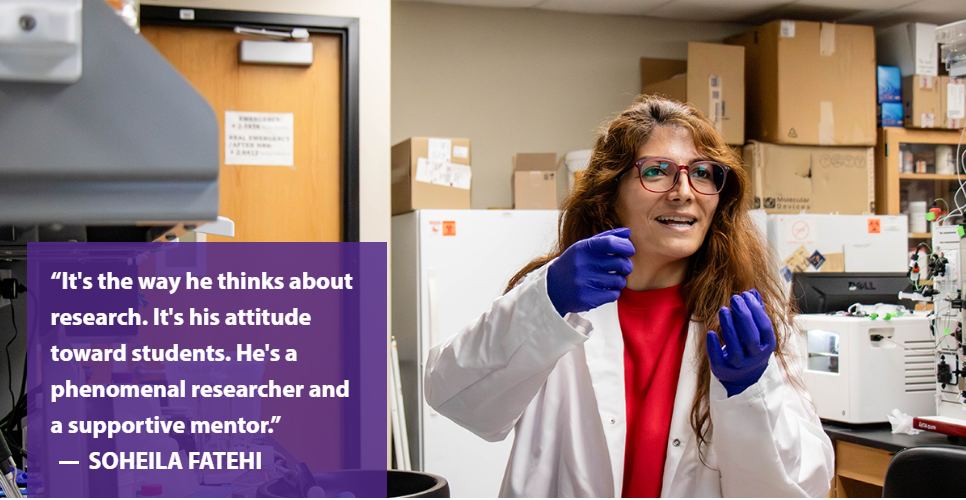
"He's everything you want in a research mentor," said Fatehi, a doctoral candidate in biochemistry. "It's the way he thinks about research. It's his attitude toward students. He's a phenomenal researcher and a supportive mentor."
While other schools involved in medical research might stock labs with ranks of postdoctoral scientists, the professor said he has most enjoyed living K-State's land-grant mission to develop the next generation of researchers.
"Graduate students are the lifeblood of what we do," he said. "This group is what makes honors like this possible. They show up, do their experiments, evaluate their data and collaborate with me. I might sketch out the scope of a project, but it's their work.
"That's how my lab runs," he continued. "That's how our entire department runs. That's what makes this place work."