


BY: SHERMAN SMITH Kansas Reflector
EMPORIA — Kaila Mock says Medicaid expansion would help small business owners like her, the people she employs at Trox Gallery and the 104 artists whose work appears in the store.
And she isn’t fond of GOP legislative leaders who claim that Medicaid expansion would serve “able-bodied adults” who don’t want to work.
“I mean, it’s kind of bulls***,” Mock said. “There are a lot of people who work really hard but just aren’t making the ends meet, especially with everything being so expensive now. I know a ton of these artists work really hard at their craft and are hustling and going to different craft shows and selling stuff here and doing everything they can, but it’s just not enough.”
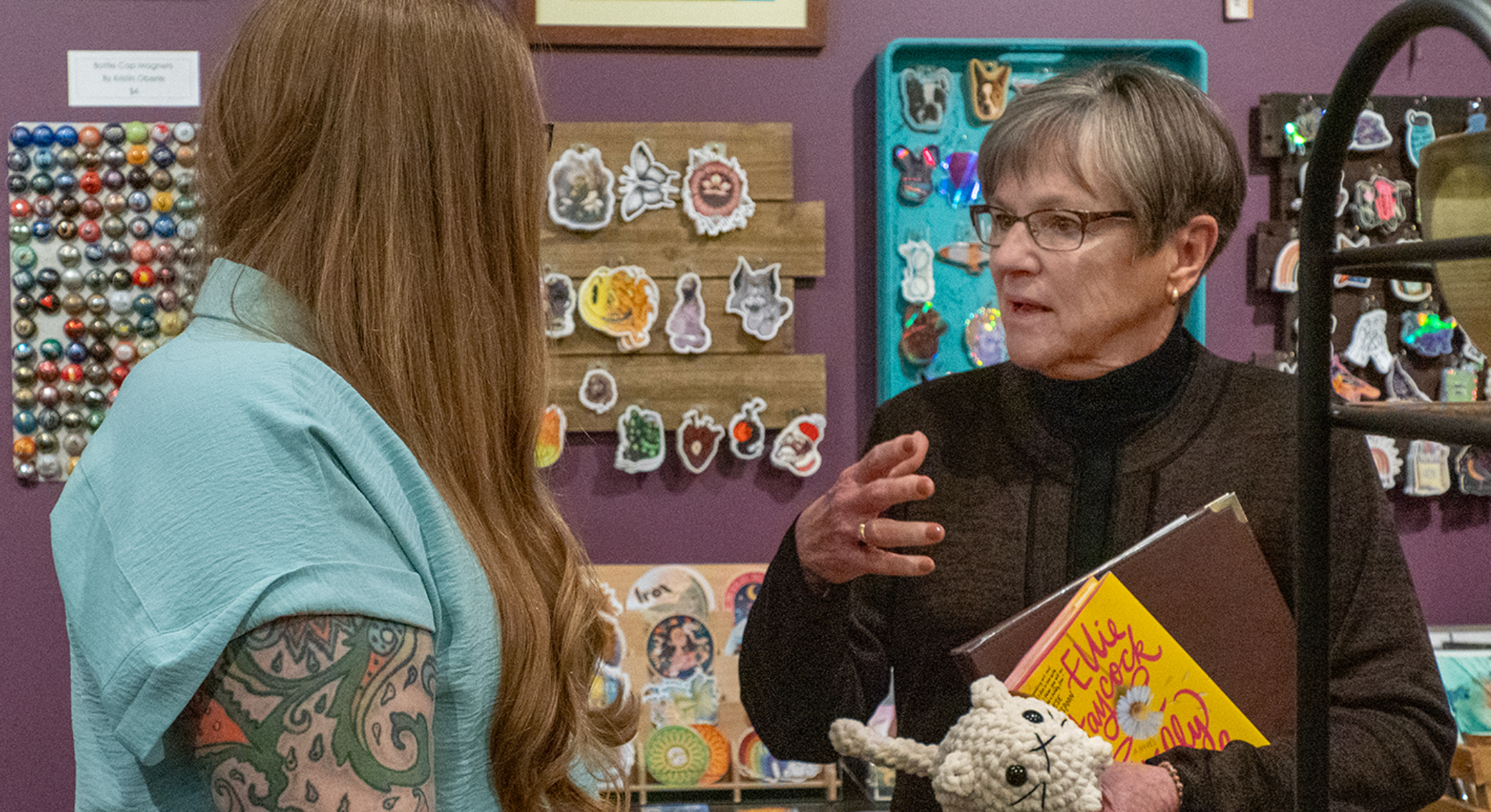
Mock met with Gov. Laura Kelly, who purchased a small crotched cat from the art gallery during a tour Thursday of main street businesses in Emporia.
Kelly made her final pitch for Medicaid expansion in a speech at the Granada Theatre, after months of touring the state and pressuring lawmakers to embrace her plan to provide health care coverage to 152,000 low-income Kansans at no additional cost to the state’s taxpayers. She urged the crowd of about 75 people to call legislators ahead of a procedural vote Friday in the Senate.
But she acknowledged the odds were against the Legislature approving Medicaid expansion this year.
“I’m not a bookie,” she said, before adding: “Honestly, I will be surprised.”

The governor said she has met with leaders in health care, child care, retail, hospitality, banking, real estate, aerospace, law enforcement and the medical community during her statewide campaign to support Medicaid expansion. House Speaker Dan Hawkins, R-Wichita, and Senate President Ty Masterson, R-Andover, responded by calling her efforts a “welfare tour.”
Kelly said Hawkins and Masterson have “skewed the facts,” “spread myths” and peddled “false rhetoric” to the public while working behind the scenes to prevent a vote on legislation that would expand Medicaid.
Before lawmakers adjourned for a three-week break earlier this month, Senate Minority Leader Dinah Sykes, D-Lenexa, made a motion to advance a Medicaid expansion bill. That procedural vote, which required approval from 24 out of 40 senators, failed on Friday when only 18 senators voted in favor of it. Even if it were successful, a second procedural vote would have required approval from 27 senators before they could consider the actual bill.
“I think that’s evidence quite honestly of the fact that if rank-and-file legislators were given an opportunity to debate and vote on Medicaid expansion, it would pass, and that’s why there’s been a reluctance to give them the opportunity,” Kelly said.
Kansas is one of 10 states that haven’t expanded Medicaid under the Affordable Care Act. Currently, the federal government covers 60% of the state’s program costs. If expanded, the federal government would pay for 90% of the additional costs. That would bring about $700 million in federal money into the state every year. Instead, tax collections from Kansas are being distributed to other states.
The Kansas version of Medicaid is available to people who earn up to 38% of the federal poverty level. For a family of four, the annual income limit is $11,400. By expanding eligibility to 138% of the federal poverty rate, the annual income threshold for a family of four would be $41,400.
About 70% of the adults who would benefit from Medicaid expansion are already working. Others are college students, caretakers or suffering from chronic illness.

While in Emporia, the governor toured the Axe Shedd, where she declined to throw an axe, and the Sweet Granada, a candy store physically connected to the theater, where the governor snagged some chocolate-covered popcorn.
At the Trox Gallery, she was approached by Jean-Ellen Kegler, a former director of the city’s visitor’s bureau, who said she moved back to Kansas after being gone for 25 years because Kelly was governor.
Kegler, now retired, also expressed dismay about the messaging from GOP leaders that Medicaid expansion would benefit people who are too lazy to work.
“We’ve heard that ever since the New Deal: ‘People are lazy. People are trying to bilk the government.’ And I think if we’re honest with ourselves, we see who is bilking the government, and it’s not the poor,” Kegler said. “It’s those who have money. And I don’t like to use the word ‘greed,’ but in this case, we’re seeing the greedy side of capitalism.”