


By: Morgan Chilson
Kansas Reflector
TOPEKA — State officials answered a key question this week underpinning the complex financing of the Kansas City Chiefs stadium, outlining boundaries of a district that will use sales taxes and revenue to fund part of the deal that includes public and private monies.
STAR bonds, or sales tax and revenue bonds, were approved by the Kansas Legislature in 2024 to provide partial funding for the $3 billion domed stadium planned in Wyandotte County, as well as an additional $1 billion for a Chiefs headquarters and training facility in Olathe and a mixed-use district.
The public funding portion is also provided through the Attracting Professional Sports to Kansas Fund, which was established to fund the stadium.
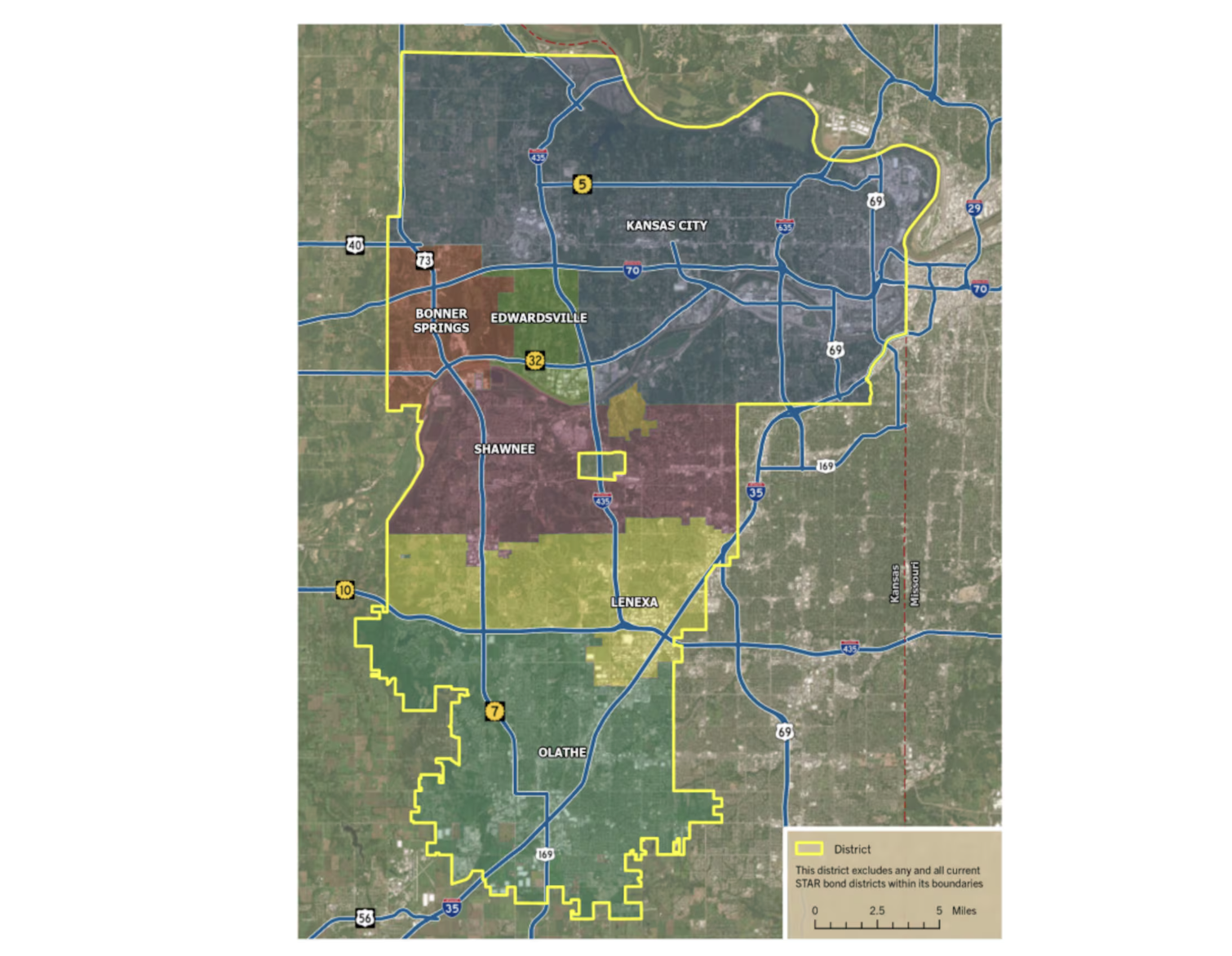
The proposed map, which encompasses most of Wyandotte County and part of Johnson County, looks much like it did when the district was first proposed, said Denise Rendina, spokeswoman for Lenexa, one of the cities in the district.
“For Lenexa, nothing’s changed since the original announcement,” she said. “Sales tax and revenue STAR bonds will not affect the city’s local sales tax or other local revenues, nor will they impose any new sales tax on Lenexa residents.”
In a STAR bonds district, a revenue baseline is defined by current collections in the district, and then sales tax generated from new revenue above that base will be used to fund part of the stadium.
The district boundaries include areas surrounding and in between the stadium and the headquarters, said Patrick Lowry, spokesman for the Kansas Department of Commerce.
Three geographic areas are specifically excluded: the University of Kansas Medical Center complex and the area immediately surrounding it, a portion of the City of Shawnee that is predominantly vacant, and existing STAR Bond districts, a news release said.
“Proximity to the project itself – or lack thereof – determined which cities were included,” Lowry said.
Baseline revenue hasn’t been set.
“The STAR Bonds project base will be established in the revenue study and released as part of the project plan once it is adopted by the Secretary of Commerce,” Lowry said in an email. “The revenue study will be considered final once STAR Bonds are issued.”
Stadium funding and whether Kansas should be kicking in so much toward the cost of the project that has been controversial from the start. One national expert says stadiums have never paid off for local communities.
Wyandotte County and Kansas City, Kan., took their concerns about the state deal to court. They filed a lawsuit in Wyandotte District Court last week.
The lawsuit asks the court to intervene in what the governments see as state interference in local control, specifically to stop implementation of House Bill 2466, or the Kansas Sports Facilities Authority Act, which allowed the state to make deals with the Chiefs and the Kansas City Royals to bring their stadiums across the state line.
“House Bill 2466 does more than invite a stadium to Wyandotte County,” the entities said in an initial 74-page court filing. “For one project, in one community, it removes the local government’s power to tax, to zone and plan, to set and collect local fees, and to provide utility service through the community’s own publicly-owned utility. It gives those powers to a new state authority whose actions may not conflict with a private agreement with the Kansas City Chiefs, and whose board includes a member chosen by the team itself.”
Asked whether the lawsuit could delay the stadium’s completion, Lowry said the department doesn’t comment on pending legal actions but added that the project is currently on time, with the Chiefs expected to play in the stadium in 2031.
-----------------
Kansas Department of Commerce
TOPEKA – Lieutenant Governor and Secretary of Commerce David Toland today published the boundaries for the Kansas City Chiefs STAR Bonds District, as authorized by K.S.A. 12-17, 160 et. al.
The STAR Bond district will collect new sales tax revenues to finance the construction of the $3 billion state-of-the-art domed stadium in Wyandotte County, the Chiefs headquarters and training facility in Olathe and portions of the surrounding mixed-used development.
The district represents a diverse revenue stream that includes the cities of Kansas City, Bonner Springs, Edwardsville, Shawnee, Lenexa and Olathe. The map was designed around clear goals shared by the Administration and the Legislature:
- Maximize the economic impact of the project
- Pay the bonds off as early as possible so those revenues can be directed to the State and participating local communities
This map determines the area from which the State will pledge incremental State sales-tax revenues that currently do not exist. It does not affect any pledge of local revenues.
Three geographic areas are specifically excluded from the district: The University of Kansas Medical Center complex and the area immediately surrounding it, a portion of the City of Shawnee that is predominantly vacant, and existing STAR Bond districts.
“Establishing the district boundaries moves us one step closer to building the Chiefs’ new state-of-the art domed stadium in Kansas,” Lieutenant Governor and Secretary of Commerce David Toland said. “This is a once-in-a-generation economic opportunity for Kansas and we will ensure that all Kansans enjoy the benefits of this new stadium for many, many years to come.”
The $4 billion project, which includes $1 billion of mixed-use development, will be financed through a public-private partnership. The public portion is funded through the STAR Bonds as well as the Attracting Professional Sports to Kansas Fund – established for this purpose – to ensure there will be no new state taxes and no impact on the state budget.
Once fully operational, the Chiefs project will create more than 4,000 new permanent jobs and generate $1 billion in annual economic impact.
The Chiefs will begin playing in the new stadium, which will be owned by the people of Kansas and leased to the team, in 2031. The newly appointed Kansas Sports Facilities Authority will oversee the new stadium and practice facility. By statute, the 11-member Authority will oversee the construction, financing and management of the sports facilities and associated infrastructure.