


MATTHEW HARDING
KSStorm.Info
If you polled 100 meteorologists, I would venture to guess 70% of them would tell you the song “Cruel Summer,” sung by Travis Kelce‘s girlfriend (you know…T-Swizzle) is about the weather. They would be wrong, but you couldn’t blame them for thinking that.
Indeed, for everything great about the summer months, it can be quite cruel. Days of relentless heat can take a toll on us physically, our air conditioners, and in the most extreme circumstances, the electrical infrastructure. More to the point, when you break down all the weather-related fatalities, there is one that stands alone.Heat.Before we get into how to protect yourself from the heat, let’s start by talking about the heat index, and giving you some of the watch, warning, and advisory verbiage the National Weather Service will be using to raise awareness about it this coming summer.
Hot Town, Summer in the City
We’ve all heard this at some point: “Currently in Hutchinson, it’s 95 but feels like 110.” The summer version of the “feels like” temperature is called the heat index, a measure of how hot it feels when relative humidity is factored in.There is a second heat scale, called the Wet Bulb Globe Temperature, that is more skewed for athletes and those who work outdoors. We’ll come back to the Wet Bulb Globe Temperature in a later article.
Generally, the heat index table looks like this:
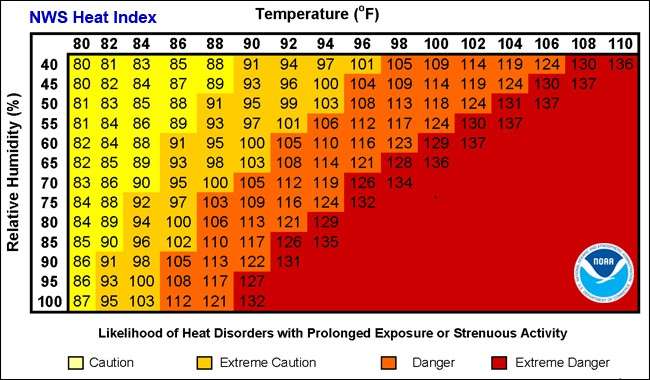
The higher the relative humidity, the greater the likelihood of heat illness with prolonged exposure or strenuous activity.Now, about that lingo…When you hear me or Scott talk about heat advisories, watches or warnings on the air, here is what we mean:
HEAT ADVISORY: Typically less than 12 hours in length and generally issued when maximum heat indices of 105 or higher are forecast.
EXCESSIVE HEAT WATCH: Issued when there is a greater than 50% confidence of the area experiencing a days-long stretch of daytime heat indices above 105 degrees, overnight lows at 80 and above, or both.
EXCESSIVE HEAT WARNING: Issued when excessive heat indices above 105 degrees, or lows above 80 are ongoing or are anticipated. The warning means the expected impacts are forecast to last for at least two days.
How to Protect Yourself
According to the Centers for Disease Control and Prevention, heat is the number one weather-related killer in the United States. Each year, over 1,220 people are killed by extreme heat. That’s more than tornadoes, hurricanes, floods, lightning, and extreme cold.And each heat-related death is 100% preventable, too.Protecting yourself from excessive heat takes some planning and generally comes down to three things: 1) Planning for the heat 2) dressing for it, 3) knowing your body and the warning signs:
Planning for the Heat
- Stay in air-conditioned places as much as possible, especially between 10 am and 7 pm
- If the air conditioner goes out in your home, consider going for a drive or to a library
How to Dress for the Heat
- Wear light-weight, light-colored clothing. Dark-colored clothing is much more efficient at absorbing the sun’s rays than lighter-colored clothing
- Wear sunscreen. Sunburn affects your body’s ability to cool down and can make you dehydrated. If you must go outdoors, protect yourself from the sun by wearing a wide-brimmed hat, sunglasses, and by putting on sunscreen of SPF 15 or higher 30 minutes before going out. Reapply as needed.
Knowing Your Body
- Cut down on exercise during the heat. If you’re not accustomed to working or exercising in a hot environment, start slowly and pick up the pace gradually. If exertion in the heat makes your heart pound and leaves you gasping for breath, STOP all activity. Get into a cool area or the shade, and rest, especially if you become lightheaded, confused, weak, or faint.
- Drink more fluids, regardless of how active you are. Don’t wait until you’re thirsty to drink.
- Avoid alcoholic and sugary drinks
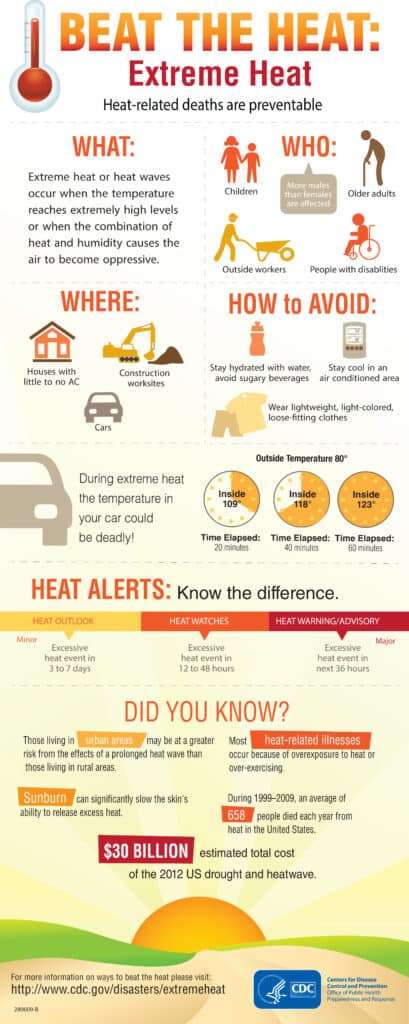
The CDC has a great infographic to summarize how to stay safe in the heat!
CLICK HERE to download the Hutch Post mobile app.
CLICK HERE to sign up for the daily Hutch Post email news update.