


WASHINGTON (AP) — The prospect of a second round of talks was uncertain Tuesday after Iran’s chief negotiator said Iran would not negotiate in the face of threats while U.S. President Donald Trump offered mixed messages about the path ahead for the U.S. war against Iran, declaring that he was in no rush to end the conflict.
Mohammed Bagher Qalibaf, Iran’s chief negotiator and parliament speaker, wrote in a post on X early Tuesday that “We do not accept negotiations under the shadow of threats,” and the Islamic Republic has been preparing “to reveal new cards on the battlefield.”
Trump indicated that he still expects to dispatch his negotiating team, led by U.S. Vice President JD Vance, to Pakistan’s capital of Islamabad for talks, even as Iran insisted it would not take part until the U.S. leader dialed back his demands. Trump said he’s “highly unlikely” to renew the ceasefire before it expires Wednesday.
Since the war started, fighting has killed at least 3,375 people in Iran and more than 2,290 in Lebanon. Additionally, 23 people have died in Israel and more than a dozen in Gulf Arab states. Fifteen Israeli soldiers in Lebanon and 13 U.S. service members throughout the region have been killed. As of April 20, Department of War and Pentagon data indicated that 415 U.S. service members have been wounded in the ongoing conflict with Iran.
Here is the latest:
No delegation from Iran in Islamabad, state TV
Iranian state television on Tuesday issued an on-screen alert saying that “no delegation from Iran has visited Islamabad ... so far” as speculation about possible talks with the United States grows.
The on-screen alert likely reflects the internal debate ongoing within Iran’s theocracy as it weighs how to respond to the U.S. Navy’s seizure of an Iranian container ship over the weekend.
Iranian state television long has been controlled by hard-liners within Iran’s theocracy.
So far, no official has acknowledged that a delegation will be heading to Islamabad, where officials have been on standby for days now for the possible talks.
U.S. Vice President JD Vance is expected to lead an American team to the talks.
Iran has offered no word on who could lead its delegation.
Last time, parliamentary speaker Mohammad Bagher Qalibaf led the Iranian side.
China says war is at ‘critical stage of transition’
China says that it hopes all parties can maintain the momentum for peace talks, as the two-week ceasefire in the Iran war is set to expire Wednesday.
“The current situation is at a critical stage of transition between war and peace. At such a moment, it is all the more necessary for all parties to show the utmost sincerity, remain committed to a political solution, maintain the momentum of the ceasefire and negotiations,” Chinese Foreign Affairs Ministry spokesman Guo Jiakun said.
Chinese President Xi Jinping called for the reopening of the Strait of Hormuz on Monday.
While it’s not directly involved in ongoing mediation efforts, diplomats have said that China had pressed for Iran to attend the first round of negotiations.
Pakistan says China supports efforts to facilitate talks
China has expressed support for Pakistan’s efforts to facilitate engagement between the United States and Iran for peace and stability in the region and beyond, Pakistan’s Foreign Ministry said Tuesday.
The ministry said Chinese Ambassador Jiang Zaidong conveyed the message during a meeting with Foreign Minister Ishaq Dar in Islamabad, where both sides discussed the latest regional developments.
Dar reaffirmed the “all-weather” Pakistan-China strategic cooperative partnership, underscoring strong bilateral ties and the importance of continued high-level exchanges, the statement said.
Thousands of security personnel deploy in Islamabad
Security has been tightened across Pakistan’s capital, where authorities have deployed thousands of personnel and increased patrols along routes leading to the airport, as U.S. and Iranian delegations are expected to arrive this week for the second round of talks, witnesses and officials said Tuesday.
Security arrangements appear stricter than those put in place during the first round of talks held in the capital on April 11 and 12, following diplomatic efforts by Pakistan and regional countries, including China, to ease tensions in the region.
Pakistan hasn't announced final dates for the talks, however.
Analysts say the scale of the security measures suggests the possibility of high-level participation if negotiations make progress.
“The arrangements this time are markedly different from those during the first round,” said Syed Mohammad Ali, an Islamabad-based security analyst.
“Pakistan appears to be preparing for the possibility of visits by top U.S. and Iranian leaders if the talks advance to a stage where an agreement could be signed,” he told The Associated Press.
EU ministers meet on energy, jet fuel concerns
Transportation ministers from across the 27-nation European Union are meeting in Brussels Tuesday to discuss spiking energy prices because of the war in Iran, and how to protect consumers at home and at the pump after the head of the International Energy Agency warned that Europe has “maybe six weeks” jet fuel supplies remaining.
“This evolving geopolitical crisis in the Middle East has highlighted that Europe may have a short-term issue in supply of fuel,” said Cyprus Transport Minister Alexis Vafeades, who is chairing the virtual meeting.
He said that there is currently no crisis, but that the bloc must prepare for the possibility of shortages.
“If this ever happens, it will affect connectivity, it will affect every citizen in the union,” Vafeades said.
“We need to be ready to avoid queues at the gas stations if this ever happens.”
Pakistan and Egyptian foreign minister speak
Pakistani Foreign Minister Ishaq Dar on Tuesday spoke with Egyptian counterpart Badr Abdelatty to discuss the latest regional developments, as part of a diplomatic push linked to a possible second round of talks between the United States and Iran.
Pakistan’s Foreign Ministry in Islamabad said in a statement that both leaders emphasized the importance of dialogue and engagement for peace and stability and agreed to remain in close contact.
The statement gave no further details.
While Pakistani officials have expressed confidence that Iran will send a delegation late Tuesday, there has been no formal announcement from Tehran.
Trump said over the weekend that he's sending a U.S. delegation to Pakistan.
President Donald Trump offered mixed messages on Monday about the path ahead for the U.S. war against Iran, declaring that he was in no rush to end the conflict while also expressing confidence that further negotiations with Tehran will soon take place in Pakistan.
With the 14-day ceasefire to expire Wednesday, Trump whipsawed in telephone interviews and social media posts between measured optimism that a deal could soon be reached and warning that “lots of bombs” will “start going off” if there's no agreement before the ceasefire deadline.
Trump indicated that he still expects to dispatch his negotiating team, led by Vice President JD Vance, to Pakistan's capital of Islamabad for a second round of talks, even as Iran insisted it would not take part until Trump dialed back his demands.
Iran’s chief negotiator and parliament speaker, Mohammed Bagher Qalibaf, accused the United States of wanting Iran to surrender and added that on the contrary, Iran has been preparing “to reveal new cards on the battlefield."
“We do not accept negotiations under the shadow of threats,” Qalibaf wrote in a post on X early Tuesday.
Trump insisted he feels no pressure to end the war until Iran agrees to his terms.
“I am under no pressure whatsoever,” Trump said on his Truth Social platform, “although, it will all happen, relatively quickly!”
Pakistani officials moved ahead with preparations for a new round of talks between the U.S. and Iran as the tenuous ceasefire was further strained over the weekend by renewed conflict around the Strait of Hormuz.
Trump told Bloomberg News he was “highly unlikely” to renew the ceasefire.
Iran holds out on resuming negotiations
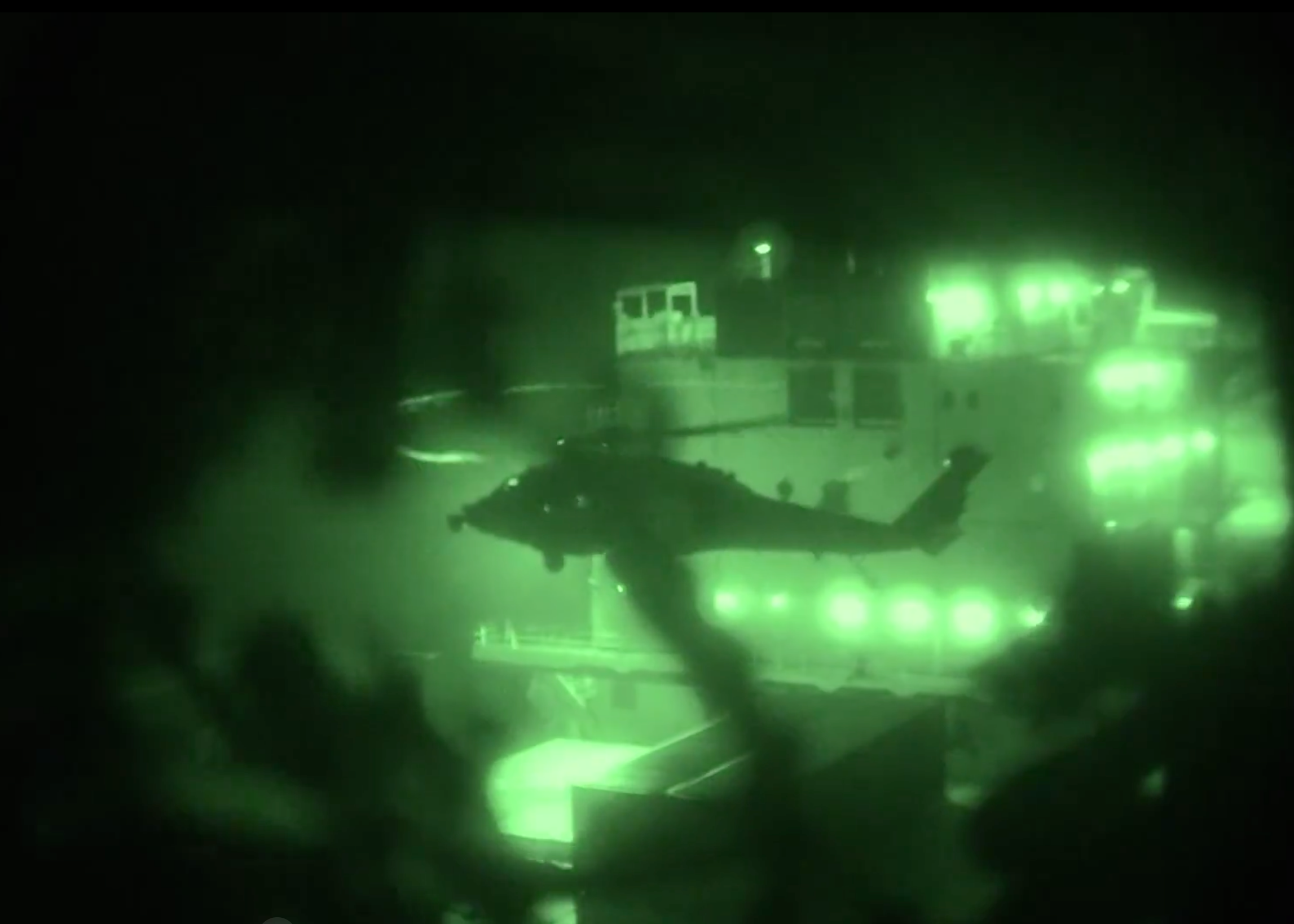
Tensions flared after the U.S. Navy attacked and seized a ship on Sunday that it said was trying to evade its blockade of Iranian ports. On Saturday, Iran fired at vessels and abruptly stopped traffic in the strait, abandoning its promise to allow some ships to pass and claiming the U.S. was not holding up its side of the ceasefire.
The U.S. actions are “incompatible with the claim of diplomacy,” Iranian Foreign Minister Abbas Araghchi said Monday in a social media post.
He gave no indication what Iran will do after the ceasefire expires or whether Iran will return to a second round of negotiations with the U.S.
Over the weekend, Iran said it had received new proposals from the U.S. but suggested that a wide gap remains between the sides. Issues that derailed the last round of negotiations included Iran’s nuclear enrichment program, its regional proxies and the strait.
Iran has throttled traffic through the strait, which connects the Persian Gulf to the open seas, since shortly after the U.S. and Israel attacked Iran on Feb. 28 to start the war. The U.S. has also instituted a blockade of Iranian ports. Roughly one-fifth of the world’s oil trade normally passes through the strait.
Trump swipes at war critics, seeks to calm investors
The U.S. president lashed out at war critics at home who are urging him to wrap up the conflict that began more than seven weeks ago.
“How bad is it that when you are in the middle of negotiations and you have got the Iranians in a perfect position, including being militarily defeated, and you have Democrats and some Republicans asking to settle it now?” Trump told the New York Post.
Even as Trump bristled at his detractors, he sought to soothe jittery investors as U.S. stocks slipped modestly Monday, following the chaotic weekend in the Persian Gulf.
The president found himself remonstrating his energy secretary, Chris Wright, who on Sunday said American motorists might not see gas prices fall back into the $3 per gallon range until late this year or next year.
“I disagree with him totally. I think it’ll come roaring down if it ends,” Trump told PBS. “If we end it, if Iran does what they should do, it will come roaring down.”
Israel-Lebanon talks to resume, official says
Meanwhile, historic diplomatic talks between Israel and Lebanon were set to resume Thursday in Washington, an Israeli, a Lebanese and a U.S. official said. All three spoke on condition of anonymity to discuss the behind-the-scenes negotiations.
The Israeli and Lebanese ambassadors met last week for the first direct diplomatic talks in decades. Israel says the talks are aimed at disarming Hezbollah and reaching a peace agreement with Lebanon.
A 10-day ceasefire began Friday in Lebanon, where fighting between Israel and Iranian-backed Hezbollah militants broke out two days after the U.S. and Israel launched their war on Iran. Fighting in Lebanon has killed more than 2,290 people.
In two separate encounters on Monday, the Israeli air force struck and killed Hezbollah militants that the military said approached its troops in a threatening way. Israel has carried out several airstrikes since the ceasefire went into effect.
Hezbollah said it detonated explosives Sunday in an Israeli convoy inside Lebanon.
Iran says more than 3,000 have been killed in the country so far
Since the war started, at least 3,375 people have been killed in Iran, according to a new toll released Monday in official Iranian media by Abbas Masjedi, the head of Iran’s Legal Medicine Organization.
He did not break down casualties among civilians and security forces, saying instead that 2,875 were male and 496 were female. Masjedi said 383 of the dead were children 18 years old and younger.
Additionally, 23 people have died in Israel and more than a dozen in Gulf Arab states. Fifteen Israeli soldiers in Lebanon and 13 U.S. service members throughout the region have been killed.