


By DAVE SKRETTA
AP Sports Writer
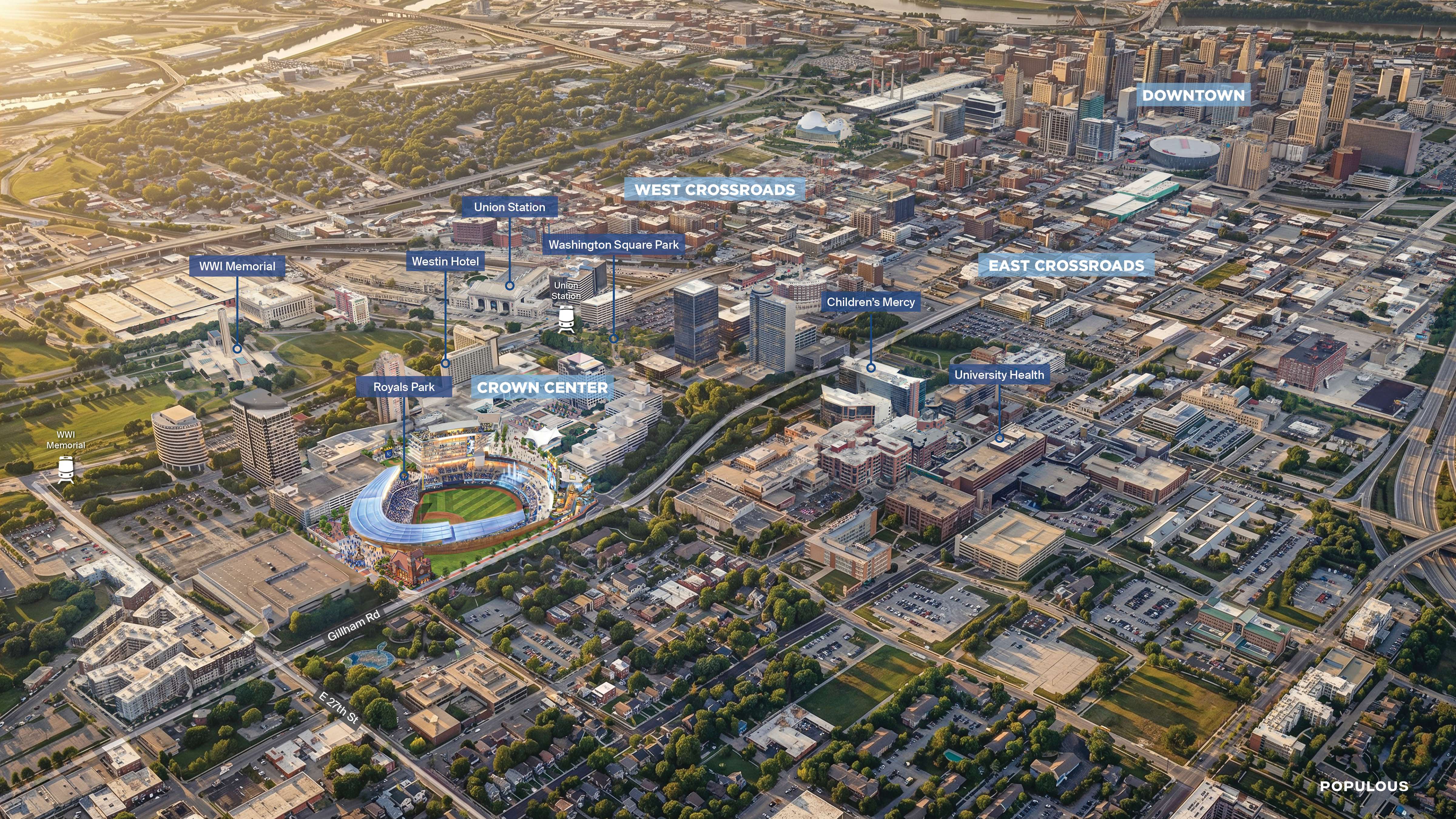
KANSAS CITY, Mo. (AP) — The Kansas City Royals are moving from their longtime home at Kauffman Stadium to the downtown Crown Center area, partnering with Hallmark Cards on a $3 billion project that includes a mixed-used development with a new ballpark as its centerpiece.
Royals owner John Sherman was joined by Hallmark chairman Don Hall Jr., Missouri Gov. Mike Kehoe and Kansas City Mayor Quinton Lucas, along with other local and state dignitaries, in making the announcement Wednesday near Hallmark headquarters.
While the finalized master plan has yet to be complete, Sherman said the $1.9 billion stadium would break ground next year in the middle of Crown Center as part of the first phase of an 85-acre project. Two-thirds of the funding will come from private sources and the remaining one-third from public partners, including money earmarked by the state for stadium projects.
“This is a partnership between two treasured Kansas City institutions,” Sherman said. “We are committed to creating a vision which honors our history, the rich past of both organizations, while reinvigorating and reimagining what our future can be together.”
The announcement came about a week after Kansas City officials passed an ordinance authorizing City Manager Mario Vasquez to negotiate a $600 million deal to help the Royals move downtown. Most believed the stadium would sit on Washington Square Park, which is next to Union Station, but it will instead be located just south of it, with the park featured in the development.
Hallmark intends to build a new headquarters in the area, which is connected by a streetcar to the Power & Light District, where the T-Mobile Center serves as its anchor. That part of downtown Kansas City will provide the backdrop beyond the outfield fence.
Officials touted the availability of public parking already in the area and convenient traffic flow from nearby highways.
Missouri's contribution comes from a law enacted last year that authorized bonds covering up to 50% of the cost of new or renovated stadiums in the state, plus up to $50 million of tax credits for each stadium and unspecified aid from local governments.
“We think it's a great investment for our Missouri taxpayers, because this does not affect existing programs,” Kehoe said. “The ripple effect from this facility will truly be far-reaching into rural Missouri and other parts of the state.”
The Royals have insisted they would leave Kauffman Stadium when their lease expires at the Truman Sports Complex in 2031, and the intention of Sherman ever since purchasing the club in 2019 was to build a downtown ballpark as its replacement.
Yet reaching Wednesday's announcement did not come without plenty of pitfalls.
The biggest stumbling block came in April 2024, when the Chiefs joined the Royals in a plan to renovate Arrowhead Stadium and replace Kauffman Stadium. The plan hinged on the extension of a sales tax that had been paying for stadium upkeep, and voters in Jackson County, Missouri, overwhelmingly rejected the proposal, forcing the franchises to go their own way.
The legislature in neighboring Kansas aggressively pursued the Chiefs, committing last December to issuing $2.4 billion in bonds to cover 60% of the cost of a new $3 billion domed stadium in Kansas City, Kansas. The NFL franchise ultimately decided to move across the state line, where it also will build a new training facility in the nearby suburb of Olathe, Kansas.
Officials in Kansas briefly pursued the Royals, too, but their interest in the MLB franchise had always been lukewarm.
The Royals had been weighing several options in recent months. But they ultimately rejected an option in the suburb of Overland Park, Kansas, and allowed a deadline to pass for a site north of downtown and across the Missouri River in Clay County, Missouri.
Economists have long concluded that subsidizing stadiums isn’t worth the cost for communities because the venues pull economic activity away from other parts of the area, rather than expanding the overall economy. Yet states and cities continually provide money to renovate stadiums or build new ones — 49 of the 60 used by MLB or NFL teams are publicly owned or sit on public land.
One of the stadiums that Sherman has cited as an example of what's possible in Kansas City is Truist Park in Atlanta.
The stadium was a public-private partnership in which the Cobb-Marietta Coliseum & Exhibit Hall Authority issued up to $397 million in bonds, the county raised millions more from transportation taxes and businesses added millions in cash. The Braves contributed the remaining money for the park and The Battery, a mixed-used development, with a total cost of more than $1.1 billion.
“There are many great ballpark neighborhoods in Major League Baseball,” Sherman said, “but this is a bigger project with more land in downtown and in the heart of the city. We are bringing a modern, state-of-the-art ballpark experience to our fans, closer to our public transportation and where more people work and live.”
-----------------
Kansas City Royals
KANSAS CITY, Mo. — The Kansas City Royals and Hallmark Cards announced on Wednesday they are teaming up to bring Royals baseball and billions in private investment and economic development to Crown Center through a historic project that will enhance tourism and lift Kansas City’s profile nationally and beyond.
A world-class ballpark, surrounding mixed-use development and reimagined headquarters for both iconic institutions at Crown Center would create more than 20,000 jobs in the construction phase alone. The 85-acre development surrounding a park-like central square with fountains has little if any precedent worldwide for a professional sports project, and the expected private investment of $2 billion or more would be the largest in Kansas City history.
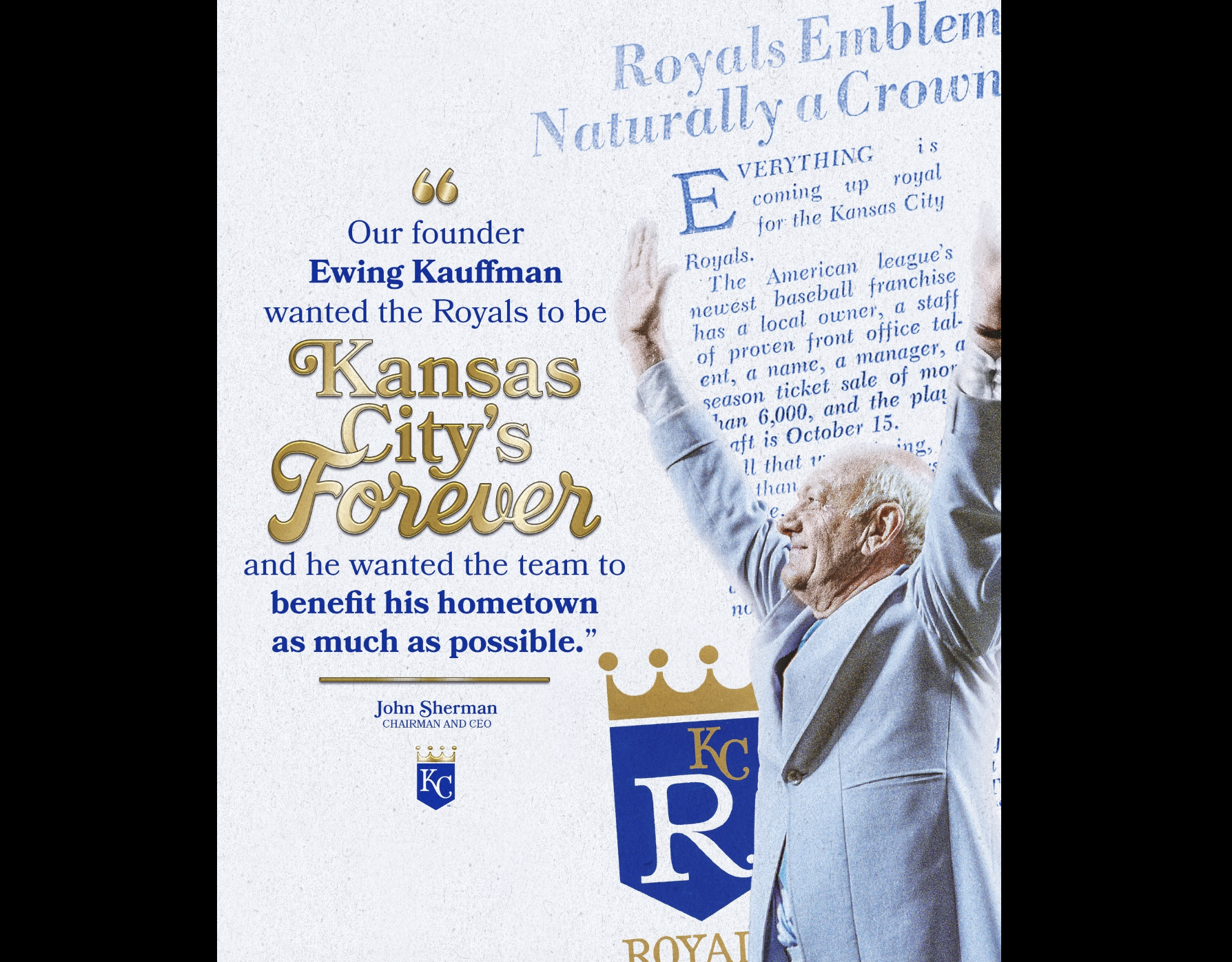
“Our founder Ewing Kauffman wanted the Royals to be Kansas City’s forever, and he wanted the team to benefit his hometown as much as possible,” Royals CEO and Chairman John Sherman said. “Joining Hallmark with this project achieves both and extends the Hall family’s critical legacy of helping Kansas City grow.”
“When the new Royals stadium opens at Crown Center, something proud will come full circle,” Hallmark Cards Executive Chairman of the Board of Directors Don Hall Jr. said. “The iconic Royals crown that Hallmark created will return to the very neighborhood where it was conceived. Every time a fan walks through the stadium doors, they’ll be standing in a place shaped by Kansas City and Hallmark’s creative spirit.”
Sherman and Hall have known and worked together for decades, including through each family’s civic and philanthropic efforts that have touched all corners of their shared hometown. That trust and mutual respect proved critical in creating a possibility that nobody would have imagined even a year ago.
The total project would be funded primarily by the Royals and other private investors and supplemented by public funding from the City of Kansas City and Missouri’s Show-Me Sports Investment Act.
“Today’s announcement reinforces that the State of Missouri is not just where the Kansas City Royals play but where they belong,” said Governor Mike Kehoe. “This decision by the Royals to invest in our state is more than just a commitment to Kansas City, it is a commitment to communities and fans across Missouri. I appreciate the partnership of the Royals organization, Hallmark and state and local leaders in working together to make this project a reality.”
This first-of-its-kind development is backed by diverse leadership groups across the region and would enhance previous investments including the Streetcar and optimize ample parking within a 10-minute walk.
Royals baseball would push from the bottom into the top 10 in walkability among Major League Baseball teams, lowering the cost and growing the accessibility for Kansas Citians to enjoy and connect with their team.
“For over 50 years, Crown Center and the Kansas City Royals have created memories that last a lifetime for the people of our region,” said Kansas City Mayor Quinton Lucas. “The public-private partnership between Hallmark, the Royals, Kansas City and our state ensures we connect our neighborhoods, keeps our downtown vibrant and maintains big league baseball in our city for generations to come. I look forward to decades of new, treasured experiences, thousands of jobs and vibrant small business growth and millions of visitors building the beating heart of our region—our downtown—while cheering on our Royals. Play ball!”