


By TIM CARPENTER
Kansas Reflector
Project relies on combination of state and federal funding, donations and bond debt
TOPEKA — The total price of constructing research and clinical facilities for the new University of Kansas Cancer Center increased nearly $80 million to accommodate plans for additional laboratory space and in response to general inflation, tariff and labor cost spikes.
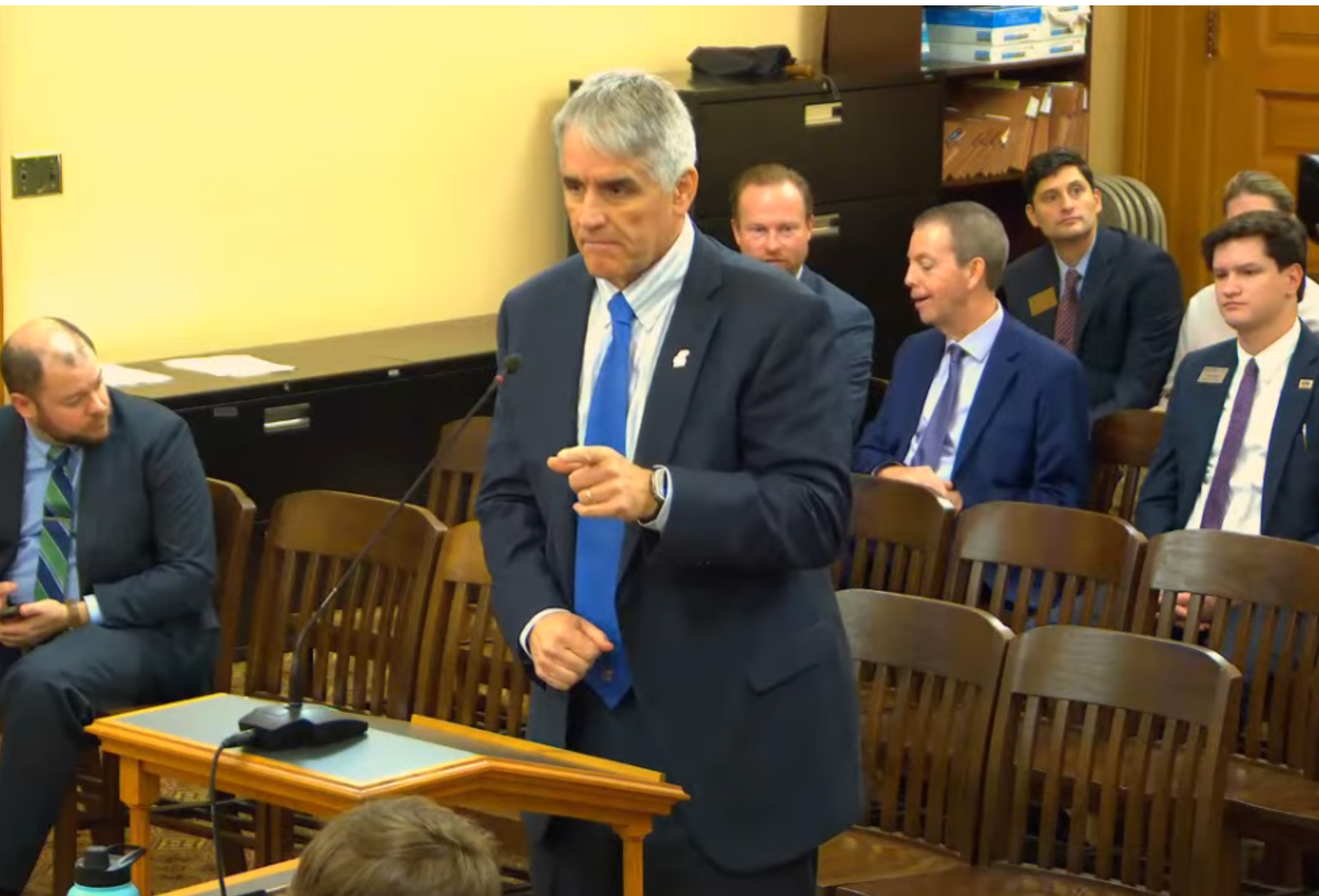
Roy Jensen, director of the KU Cancer Center, said financial requirements of transforming the campus in Kansas City, Kansas, to fulfill the promise of a coveted federal designation as a comprehensive cancer center was estimated in November 2023 to total $250 million. He said the current assessment pegged the project cost at $329 million, which would amount to a 30% escalation in the budget.
Presentations to the Kansas Legislature and Kansas Board of Regents indicated decisions to add 70,000 square feet to the project for research purposes, enough to allow 44 principal laboratories rather than the original 32, would elevate the cost by $67.5 million. Escalation in materials and labor expenses added $6 million to the bottom line. In addition, planners committed $6 million more to the contingency fund.
In May, ground was broken for the cancer center complex. The plan calls for occupancy of the new research building in February 2028. Renovation of the nearby Hemenway Life Sciences and Innovation Center would connect it to the research hub of the cancer center. The entire complex would be operational by February 2029.
“It’s going to be an incredible catalyst for, I think, further growth of the cancer center,” Jensen said. “We’re super excited to have this in progress right now.”
The cancer center complex at 39th and Rainbow campus was designed to provide patients with access to groundbreaking clinical trials and therapies, KU officials said. Physicians and researchers engaged in cancer research and treatment would be brought together to make personalized care more readily available.
Jensen said KU Medical Center attracted 8,500 new cancer patients annually, an increase from 1,700 new patients in 2004. The volume of research at the medical center has grown over the past 20 years from $14 million annually to $94 million annually, he said.
“With that significant growth, we’re in need of an expansion,” Jensen said. “We’re currently in 10 different buildings just on the medical center campus. A big reason for this project was to begin to consolidate.”
Under the revised $329 million budget endorsed by the Board of Regents, the cancer center project would rely on $75 million in state aid, $60.7 million in federal appropriations, $57.2 million in private donations, $98 million in bond debt and $38 million from cash reserves and contributions from KU Health System.
“The Legislature’s allocation of $75 million played a key role in allowing us to move forward with this project,” Jensen said. “The office of Sen. (Jerry) Moran has also been quite helpful with a number of congressionally directed spending allocations.”
Rep. Troy Waymaster, the Bunker Hill Republican chairman of the House Appropriations Committee, said unresolved pieces of the puzzle included the potential of supplemental federal funding. U.S. Senate legislation pending in Washington, D.C., would earmark $36 million more to the KU Cancer Center, which Waymaster suggested could be dedicated to reducing KU’s bond debt obligations.
Jensen said extra federal aid might moderate costs of borrowing, but the infusion also could allow shifting of resources to better incentivize hiring of cancer center researchers.
“Some of the cash on hand that’s being set aside for this building could then be used to help us to build recruiting packages to help bring new investigators to the cancer center,” he said.
In 2012, KU was federally designated by the U.S. National Cancer Institute as a clinical cancer center. KU Cancer Center was declared a comprehensive center in 2022, which was the highest level of recognition awarded by NCI.
Fifty-four comprehensive cancer centers have been established in the United States — a figure representing 1% of all cancer treatment facilities in the country, Jensen said.
“It’s impressive,” said Rep. Barbara Ballard, D-Lawrence. “I think people should know that because it didn’t happen by accident.”