


MARC JACOBS
Hutch Post
HUTCHINSON, Kan. — Environmental impacts, water use and power demand topped the concerns raised by participants at a City of Hutchinson open house as officials continue considering regulations for large-scale data centers.
The city released a community feedback summary from its Aug. 12 open house at the Hutchinson Fire Department’s Command and Training Center. More than 120 people attended the come-and-go event and provided input through voting exercises, questionnaires and written comments.
City officials stressed that the results should not be considered a statistically representative survey of Hutchinson. Participants were a relatively small, self-selected group, and some attendees lived outside the city. The feedback is instead intended to identify concerns, priorities and areas of potential agreement as the city develops regulations.
Environmental impacts received the most votes when participants were asked which issues should be most strongly regulated, with 83 selections. Water use followed with 77, power demand with 70, noise with 63 and community impacts with 55. Battery storage received 34 votes and air emissions received 35.
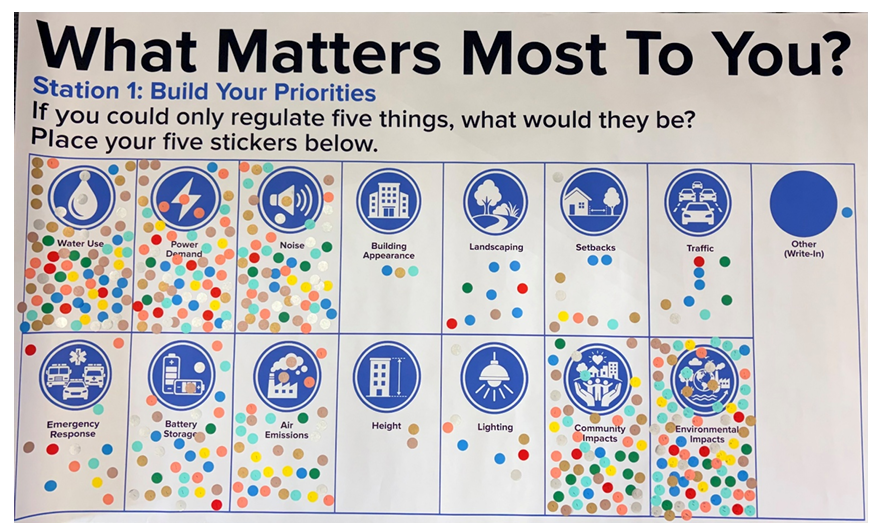
The report says written comments frequently raised concerns about water and electricity consumption, groundwater protection, noise, economic incentives, transparency and monitoring. Many participants called for either a ban or moratorium on large-scale data centers, while others suggested safeguards that should be imposed if projects are allowed.
Location was another major issue.
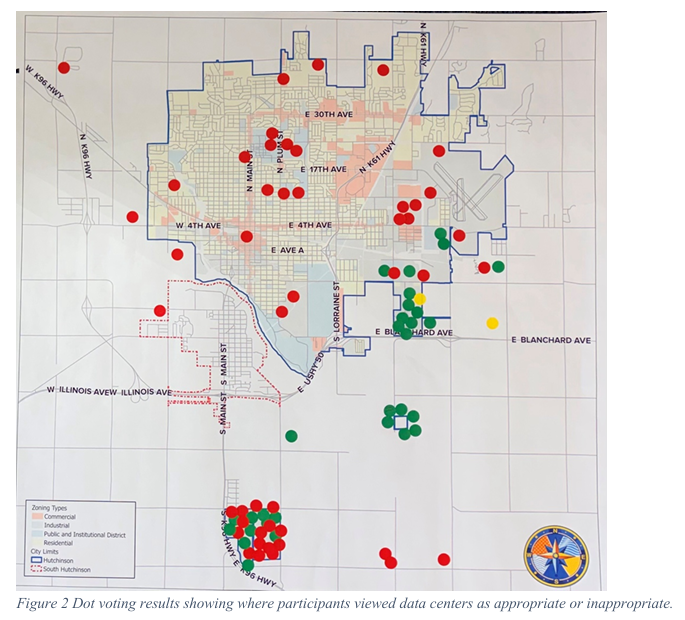
Participants generally favored keeping large-scale facilities away from established residential and commercial areas. Green dots indicating potentially appropriate locations were concentrated primarily in southeastern industrial areas, including the Kansas Enterprise Industrial Park and Kimbell Industrial Park. However, some participants placed opposition markers even in those industrial areas.
Among those answering a questionnaire about where data centers should be permitted, 20 selected industrial districts only, while no one supported allowing them in both commercial and industrial districts. Another 24 selected “Other,” with many of those written responses opposing data centers anywhere in Hutchinson or Reno County.
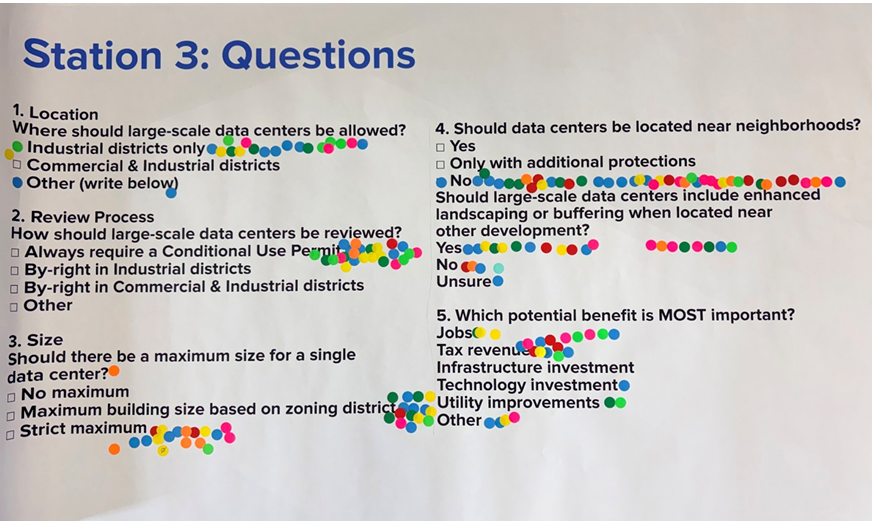
There was also strong support for requiring individual review of projects. Twenty-five participants favored requiring a conditional use permit, while no participants supported allowing large-scale data centers by right in either industrial or commercial districts.
Participants were unanimous on one questionnaire question involving residential areas. All 43 votes opposed locating data centers near neighborhoods. No one voted to allow them near neighborhoods, even with additional protections.
Size restrictions also received support. Eighteen respondents favored a strict maximum size for a single data center and 15 favored maximum building sizes based on the zoning district. No respondents supported allowing facilities without a maximum size.
When participants were asked to identify the most important potential benefit of data centers, tax revenue received 15 votes. Jobs received three, utility improvements two and technology improvements one. No one selected infrastructure investment. Another 22 participants selected “Other,” with several written comments questioning whether data centers would provide meaningful benefits to local residents.
Suggested safeguards included closed-loop cooling systems, limits on water consumption, groundwater protections, noise standards and environmental monitoring. Participants also raised questions about infrastructure costs, emergency response and eventual decommissioning. Several comments called for developers to pay infrastructure, monitoring, mitigation and cleanup costs associated with their projects.
The city said the open-house feedback is only one part of its regulatory process. Staff will also consider community focus groups, nationwide best practices and regulations adopted by other communities.
Those findings are expected to be summarized for the Hutchinson Planning Commission as staff begins identifying areas of agreement for a potential regulatory framework. The city may also conduct an online survey to seek additional public input on specific regulatory questions.