


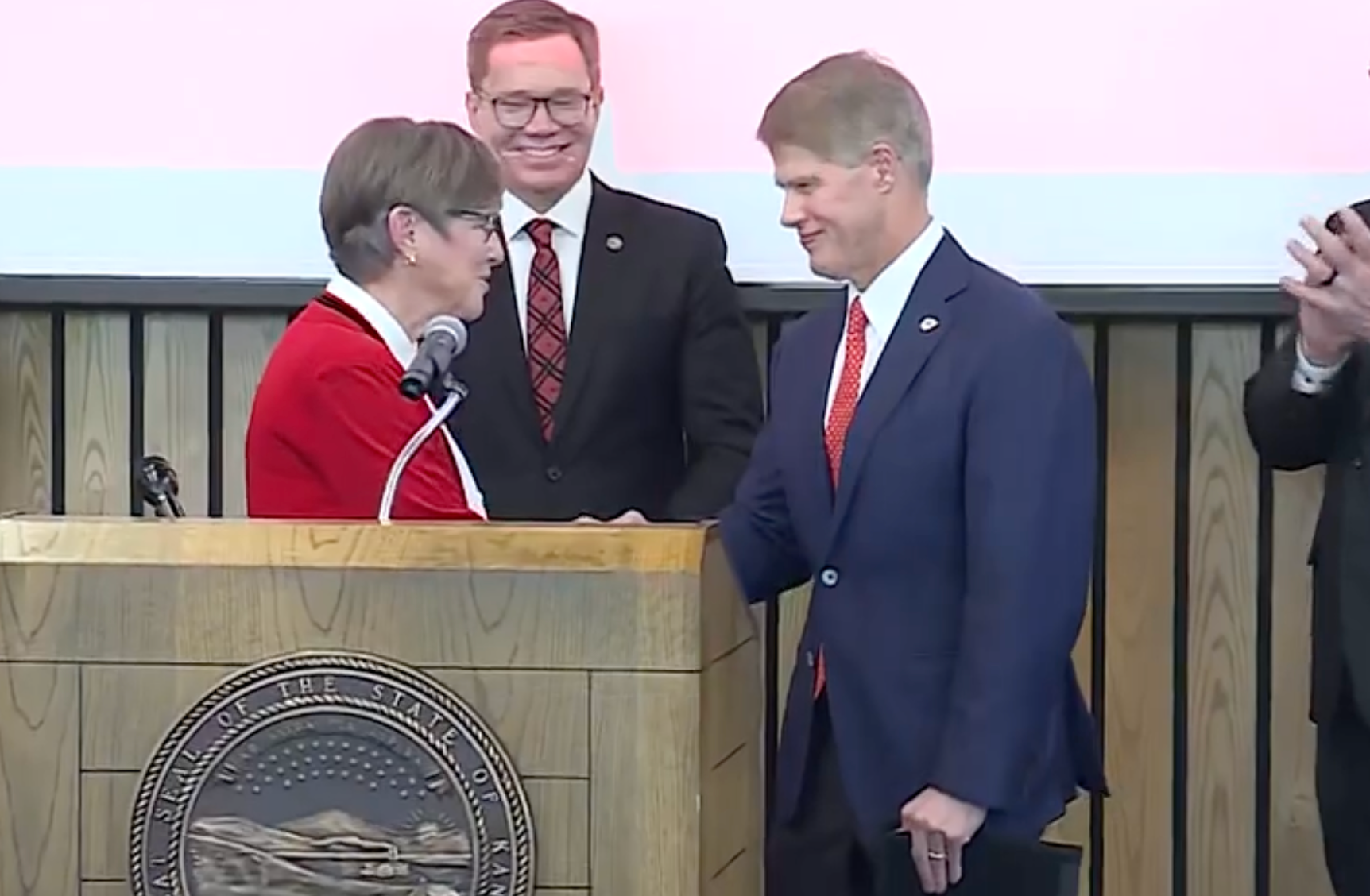
Missouri wasn’t able to put its best foot forward, House Speaker Jon Patterson said, because ‘leadership was very fragmented’
By:Jason Hancock and Jonathan Shorman
Missouri Independent
Nearly a decade after Missouri lost its NFL franchise in St. Louis to Los Angeles, the state learned Monday that the Kansas City Chiefs are moving across the state line to Kansas.

The news, rumored for days, was greeted with shock and despair in Missouri, where hopes were high that a $1.5 billion incentives package approved by state lawmakers would be enough to keep the team in Arrowhead Stadium.
In the end, a much more lucrative package from Kansas won out.
“This is a painful day for everyone in Missouri who loves our Chiefs,” said state Sen. Maggie Nurrenbern, a Kansas City Democrat.
“A lot of us in Missouri, we feel like we’ve been incredibly loyal to the Chiefs despite all of the frustrations over decades,” Nurrenbern added. “We stuck with the Chiefs every step of the way. So this is so disappointing. I can imagine that Lamar Hunt today is rolling in his grave.”
House Speaker Jon Patterson, a Lee’s Summit Republican, echoed the disappointment, saying Missouri entered into stadium negotiations at a disadvantage.
“I think money was part of it, but I think it’s also the opportunities available in Kansas,” Patterson said. “You know, Arrowhead can’t do a Super Bowl. Arrowhead can’t do a Final Four. If you have a dome stadium, those things are all possibilities, and I think that’s probably what ultimately led to the decision to move.”
Missouri wasn’t able to put its best foot forward, Patterson said, because “leadership was very fragmented.”
“Kansas leadership was very united and professional, and they just took advantage of a once in a lifetime opportunity,” he said, adding: “It would be deliciously satisfying to start pointing fingers, but I hope we can avoid that right now and just look forward.”
State Rep. Mark Sharp, a Kansas City Democrat, was not ready to be so magnanimous.
He said years of bad decisions led to Monday’s news. Specifically, he pointed to former Jackson County Executive Frank White, who was recently removed from office after a recall vote.
White, Sharp said in a social media post, “presided over a deeply dysfunctional and adversarial approach to our professional sports teams.”
Sharp also cast blame on former Gov. Mike Parson for not responding to Kansas’ efforts to poach the Chiefs before leaving office and Kehoe for waiting until nearly the end of this year’s legislative session before presenting a stadium plan.
“This crisis did not happen by accident,” he said. “It was the result of a series of preventable leadership failures.”
House Minority Leader Ashley Aune, a Kansas City Democrat, called it “legislative malpractice” that Kehoe waited until the final days of the legislative session in May to offer a counterproposal to Kansas.
Kehoe said he remained hopeful throughout the process, and that negotiations with the Chiefs’ management continued into last week. His administration has been in constant communication with both the Chiefs and the Royals, and it wasn’t until Monday morning that he was informed by the Chiefs that the team was leaving.
“Harry Truman once said ‘The Buck Stops Here,'” Kehoe told reporters at a press conference. “It’s not fun to be at the top when something like this happens, but you certainly want to try to figure out what the lessons learned here are, and moving forward, we will obviously be doing a post mortem analysis.”
This is certainly a setback, Kehoe said, “but we’ll work together to recover.”
The Chief’s ownership, Kehoe said, “decided to abandon Lamar Hunt’s legacy at the iconic Arrowhead Stadium, a place that Chiefs fans have rallied around since 1972. At Arrowhead, every game feels like a Super Bowl. No new stadium will replicate that.”
Jackson County Legislator Manny Abarca said he expects elected officials in the county, where the team is currently located, to take a closer look at how taxpayer money is spent during the remaining years of the Chiefs’ and Royals’ contracts to play at the Truman Sports Complex. Jackson County currently charges a ⅜-cent sales tax for stadium upkeep, generating millions a year.
“Honestly, at this point they’re like a bad ex-girlfriend. They won’t go away,” Abarca said of the Chiefs. “And so the reality that they want to try and go play second fiddle in Kansas and try and lure a deal that’s not written down on paper, good luck to them, best of luck. At this point, our taxpayers in Jackson County deserve a whole lot better commitment than what we’re getting.”
The Chiefs’ decision is “incredibly disappointing, said state Sen. Patty Lewis, a Kansas City Democrat. But it’s also a symptom of a larger problem.
“There are no winners in a border war, just losses on both sides,” she said. “Companies moving back and forth across the state line to reap massive tax breaks while creating no real net job growth is bad for families, bad for the region and bad for both states.”
State Sen. Nick Schroer, a Republican from Defiance, was among the lawmakers who openly opposed the incentives package for the Chiefs and Royals when it passed the legislature this summer.
“Don’t want to say ‘I told you so,’ but I warned the legislature this would happen just as it did with the Rams,” he said.
Schroer said he will be filing legislation this week “to get rid of the asinine classification of the Chiefs as Missouri’s official NFL team as it was passed just a few sessions ago. Similarly I will be getting rid of the asinine ‘handshake’ border-war resolution which says we will play nice with our neighbors next door.”
The Chiefs lease on its Kansas City stadium, which has been the team’s home since 1972, will expire after the 2030 season.
Missouri lawmakers reconvened during a special legislative session this summer to approve a spending package that would have allocated state taxes collected from economic activity at Arrowhead and Kauffman to bond payments for renovations at Arrowhead and a new stadium for the Royals in Jackson or Clay counties.
Estimated at just under $1.5 billion over 30 years, the funding would pay for half the costs — compared to 70% in Kansas — and included a requirement for additional local government financing.
The Royals first announced an intention to leave Kauffman Stadium in November 2022. The move was pitched as a way for the Chiefs to remain in Arrowhead, demolish Kauffman and build a covered entertainment center.
Officials in Jackson County and Kansas City began scrambling to figure out how to keep the Royals from leaving Missouri. By the spring of 2023, Clay County leaders announced interest in building a stadium in North Kansas City that could become the Royals new home.
The Royals solicited proposals for a downtown Kansas City and North Kansas City site a few months later, and released renderings of possible stadiums at both locations in August 2023.
Soon after, a poll was leaked to the media showing 70% of Clay County voters opposed a new sales tax to fund a stadium in North Kansas City. Despite weeks of media speculation, no one claimed credit for the poll, which was widely seen as an attempt to shake the confidence of Royals ownership in the viability of a Clay County proposal.
Critics, who called the survey a “push poll” meant to deceive the public, decried the move at the time, arguing that sabotaging any potential Missouri site would increase the chances one or both teams end up in Kansas.
It wasn’t until more than a year later that documents provided to The Independent revealed it was a political action committee formed to support Kansas City Mayor Quinton Lucas that paid for the Clay County polling. A staffer using a Lucas campaign email address requested the poll be commissioned, and his top aide obfuscated the spending by requesting it be referred to in disclosures as “research” instead of “polling.”
Jackson County voters were eventually presented with a proposed sales tax increase to fund a Royals stadium in Kansas City. Lucas threw his support behind the measure, but it was resoundingly rejected by voters.
The failed push to pay for a new Royals stadium in Missouri left the door open for Kansas lawmakers, who quickly put their own package of incentives together to lure the teams across the state line.
Lucas said negotiations with the team ran up until last week, and that the offer Missouri put forward was “very fair, but very responsible.” He worked closely with the governor and other local and state officials, and that work will continue as Missouri strives to keep the Kansas City Royals from leaving as well.
“While the Chiefs aren’t going far away, and aren’t gone yet, today is a setback for a Kansas Citian, a former Chiefs season ticket holder and a lifelong Chiefs fan,” he said.
As Missouri mourns the loss of the Chiefs, the fate of the Royals remains in flux.
The team is rumored to be eyeing a new stadium in Overland Park, Kansas. Lucas said Monday his hope is for a downtown baseball stadium, while other Missouri officials continue pushing for a North Kansas City site.
Nurrenbern and Patterson both said that, as far as they were aware, negotiations with the Royals are still ongoing.
News of the Chiefs decision to leave Missouri comes almost exactly 10 years after the state lost the St. Louis Rams.
Then-Gov. Jay Nixon was pushing for a $1 billion plan to build a new St. Louis stadium for the Rams, much to the chagrin of the legislative leadership.
Both sides tussled in the media and the courts, but the fight between the Democratic governor and GOP-dominated General Assembly fizzled after the Rams announced an intention to move to Los Angeles two days before the 2016 legislative session began.
NFL owners overwhelmingly agreed to let them do it soon after.