



MARC JACOBS
Hutch Post
HUTCHINSON, Kan. — The dogs are taking over the Kansas State Fairgrounds again, but this time, looks aren’t what matter.
Speed, precision and the connection between dog and handler will be on display as the Hutchinson Kennel Club hosts four days of agility trials in the Expo Building at the Kansas State Fairgrounds.
Unlike the Sunflower Cluster dog show held at the fairgrounds, where conformation competition is a major attraction, this weekend’s event is devoted to agility. Hutchinson Kennel Club members Missy Smith and Barbara Wgoner said the competition showcases dogs navigating obstacle courses while responding to signals from their handlers.
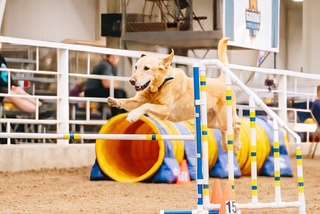
And the competition isn’t limited to purebred dogs.
Wagner competes with a mixed-breed dog, while Smith competes with a purebred border collie. Dogs must be registered with the American Kennel Club to compete, but performance events are open to both purebred and mixed-breed dogs.
For Wagner, agility began as something fun to do with her dog, Beau.
She said training can begin with basic groundwork when dogs are puppies, although jumping is generally delayed until dogs are older and their growth plates have closed. Eventually, dogs learn to tackle jumps, weave poles, tunnels, the A-frame, teeter and dog walk.
Wagner said the sport requires handlers to understand not only their dogs’ movements but their own body language.
“Agility for me is a lot of that connection with your dog,” Wagner said.
That connection becomes especially important because the dog enters the ring without ever seeing the course beforehand.
Every course is different. Handlers receive the course layout ahead of competition and are allowed to physically walk the course before their run. Their dogs, however, do not get that opportunity. Once competition begins, handlers must guide their dogs through the obstacles in the correct sequence as quickly and accurately as possible.
Smith said agility provides more than physical exercise. It also gives dogs a mental workout.
Running a dog for miles may make it physically tired, she said, but that doesn’t necessarily challenge its brain. Agility forces both dog and handler to think, with handlers determining where they need to position themselves to communicate the next obstacle.
Spectators will see several forms of agility competition throughout the weekend, including standard courses featuring obstacles such as the A-frame, teeter, dog walk, jumps and tunnels. Jumpers with Weaves features jumps, weave poles and potentially tunnels without some of the contact obstacles found on a standard course.
Competition is also divided by height, meaning smaller dogs are not racing directly against much larger breeds. Smith said that allows a small Chihuahua, for example, to compete within its own height division rather than against a much larger Belgian sheepdog.
In Time to Beat competition, the fastest clean run in a height division establishes the time everyone else is trying to beat.
The agility trials begin Thursday and continue through Sunday in the Expo Building at the Kansas State Fairgrounds. Thursday’s competition begins at 9 a.m., while competition Friday through Sunday begins at 8 a.m. Spectators can watch from bleachers inside the building.
Kennel club members are encouraging the public to attend but have a couple of requests for spectators: Leave pets and strollers at home, and always ask a handler before petting a competing dog.
For those who have never watched an agility trial, Wagner said part of the appeal is seeing just how closely dog and handler work together.
The dog may be the one clearing the jumps, racing through tunnels and weaving through poles, but success depends on a partnership — one built through training, communication and trust.