


By SEAN BOSTON
Hutch Post
HUTCHINSON, Kan. — Reno County commissioners heard sharp criticism Wednesday morning from residents urging the county to pause development of battery energy storage systems and data centers.
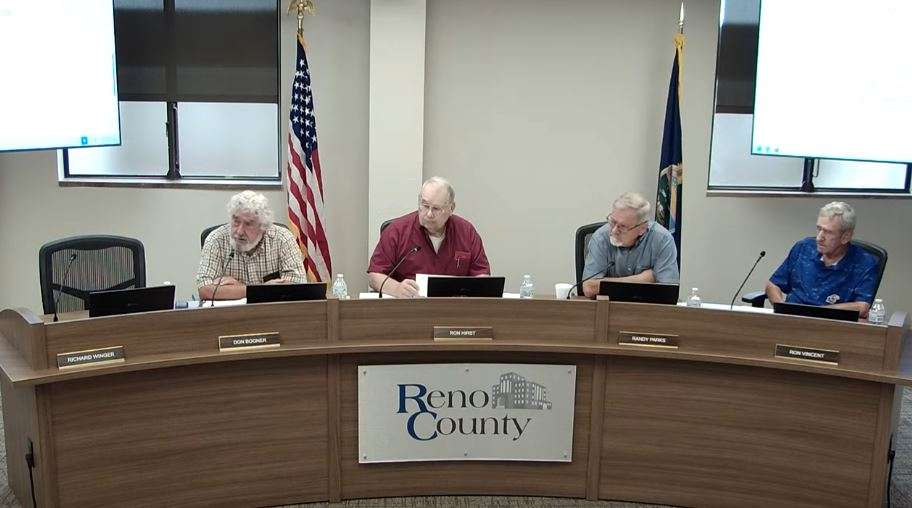
The Reno County Commission met Wednesday morning in the Veterans Room of the Reno County Courthouse. Commissioner Richard Winger was not present.
The issue was not listed as a regular agenda item, but several residents spoke during the public comment portion and asked commissioners to support a moratorium on battery energy storage systems, commonly known as BESS, and data centers.
Susie Ratzlaff, who lives on North Buhler Road, presented commissioners with signatures from 875 Reno County citizens or landowners asking for a moratorium until further study is completed.
“We’re on the same side,” Ratzlaff said. “We all want what’s best for Reno County. If we didn’t love this county and our lives here, we would just leave, but our homes and communities are worth our efforts to stop these industries from changing Reno County.”
Ratzlaff said residents have concerns about data centers’ electricity and water use, noise, diesel generators and potential long-term impacts. She also raised concerns about lithium battery fires, evacuations, contamination and the Equus Beds Aquifer.
“Who do you think has the best interest of Reno County in mind?” Ratzlaff said. “Is it families who built their lives here, sometimes for generations, or these industries who have been described as predatory and extractive?”
Vicki Jackson, of Hutchinson, asked commissioners to clearly state where they stand on the issue.
“Are you listening to what the people say?” Jackson said. “Do you hear their voices? You were elected by us.”
Jackson also questioned whether any jobs tied to the developments would go to local workers and said residents want more information about potential locations, tax abatements, water use and nondisclosure agreements.
Erin Hodgson, of South Hutchinson, said she was frustrated by what she described as a lack of transparency from county government.
“Frankly, it’s insulting to look us in the eye and pretend this isn’t happening in Reno County,” Hodgson said.
Hodgson said a moratorium would not stop economic development, but would give the county time to study the issue and rebuild trust with residents. She pointed to South Hutchinson, which she said passed a moratorium Tuesday night, and said other counties have taken similar action.
“A moratorium does not close us to business,” Hodgson said, “but it does open you as a commission to transparency and make a good faith effort to restore some pretty badly damaged trust within your voting body.”
Gary Witt, of Buhler, said he supports either a moratorium or a ban, saying residents should be able to look at other communities’ experiences before allowing similar projects in Reno County.
“I mean, you can show me the economics on it, maybe, but at this point in time, I do not see it,” Witt said.
Dr. Dawn Varney, of Hutchinson, told commissioners she opposed data centers in Reno County and cited concerns about water, noise, air pollution, light pollution, road damage and local utility costs.
“In the field of medicine, there’s a common saying: first do no harm,” Varney said.
Erin Baker, of Buhler, focused on the risks of battery storage systems and pointed to previous county discussions about lithium battery fires at the Reno County landfill.
“If one battery of this size is considered hazardous enough that you personally are warning the public to keep it out of the trash because it can start fires and does start fires, what do we call a facility or system containing the equivalent of roughly 150 million of them concentrated in one place?” Baker said.
After public comment ended, commissioners responded during their report portion of the meeting.
Commissioner Ron Vincent said the proposed battery storage issue is in his district and said he has responded to emails, phone calls and meetings with residents. He said the technology is new enough that it can be difficult to find neutral long-term information.
“There’s so much out there, and it’s such a new process that it’s really hard to get accurate information that’s not put out there by the people proposing these or the special interest groups that are against them,” Vincent said.
Vincent said the health and well-being of Reno County residents would remain the commission’s first priority.
“That will always be first and foremost,” Vincent said.
Vice Chair Randy Parks said he has listened to residents, watched videos and talked with state officials. He said he is not under a nondisclosure agreement and has tried to be as transparent as possible.
Parks said he believes the issue should be studied by the planning commission, but also said he has heard from people across the county.
“I know where the people are at,” Parks said. “I know what the people’s hearts are, and I don’t know that I can stand with this. I would probably end up being a no vote.”
Parks said a moratorium is typically a temporary pause for regulation, not something intended to last for years. He said, based on where he stands now, he may be more inclined to support a ban than a moratorium.
“I’ll stand with the position of the majority of the people in this county every time,” Parks said.
Commissioner Don Bogner said he has attended symposiums and has been researching the issue. He also addressed concerns about nondisclosure agreements, saying they are sometimes used in economic development and private contracts.
Bogner said he has signed one nondisclosure agreement in three years as a commissioner, when he was chair, because he believed he needed information to understand what a company might bring before the county.
“You asked for transparency, you got it now,” Bogner said.
Bogner also said he understands concerns about land use, utility lines and private property because he has dealt with those issues personally for decades as a farmer.
“I’ve lived every one of those scenarios you’ve talked about,” Bogner said. “I know how you’re treated. I know how they operate.”
Bogner said if there are not enough votes for a ban or moratorium, the county would need to make sure any regulations are strong.
“You better have studied everything, and you had better get the right regulations in place,” Bogner said.
Chair Ron Hirst said commissioners have been researching the issue, even if they have not publicly discussed every part of that work. He said he attended a recent Kansas County Commissioners Association meeting in Hutchinson that included a discussion on data centers and the electric industrial economy.
“There isn’t one of us commissioners up here who has failed not to study and research this,” Hirst said.
The commissioners held a study session later Wednesday morning that included discussion of data centers.