


MARC JACOBS
Hutch Post
HUTCHINSON, Kan. — Hutchinson police explained the investigative value of the city’s Flock license plate cameras during Tuesday’s City Council meeting, while council members questioned how the department protects privacy, shares information and addresses potential misuse.
Police Chief Brice Burlie reported that 11 fixed cameras are installed, with a 12th awaiting installation pending Kansas Department of Transportation approval. No expansion beyond those 12 cameras is currently planned.
The department’s annual Flock contract costs $33,000 and runs through December 2028.
Burlie said the cameras capture still images of vehicles and publicly visible license plates, along with vehicle characteristics and the date and time of each observation. The system does not record continuous video or use facial recognition, he said.
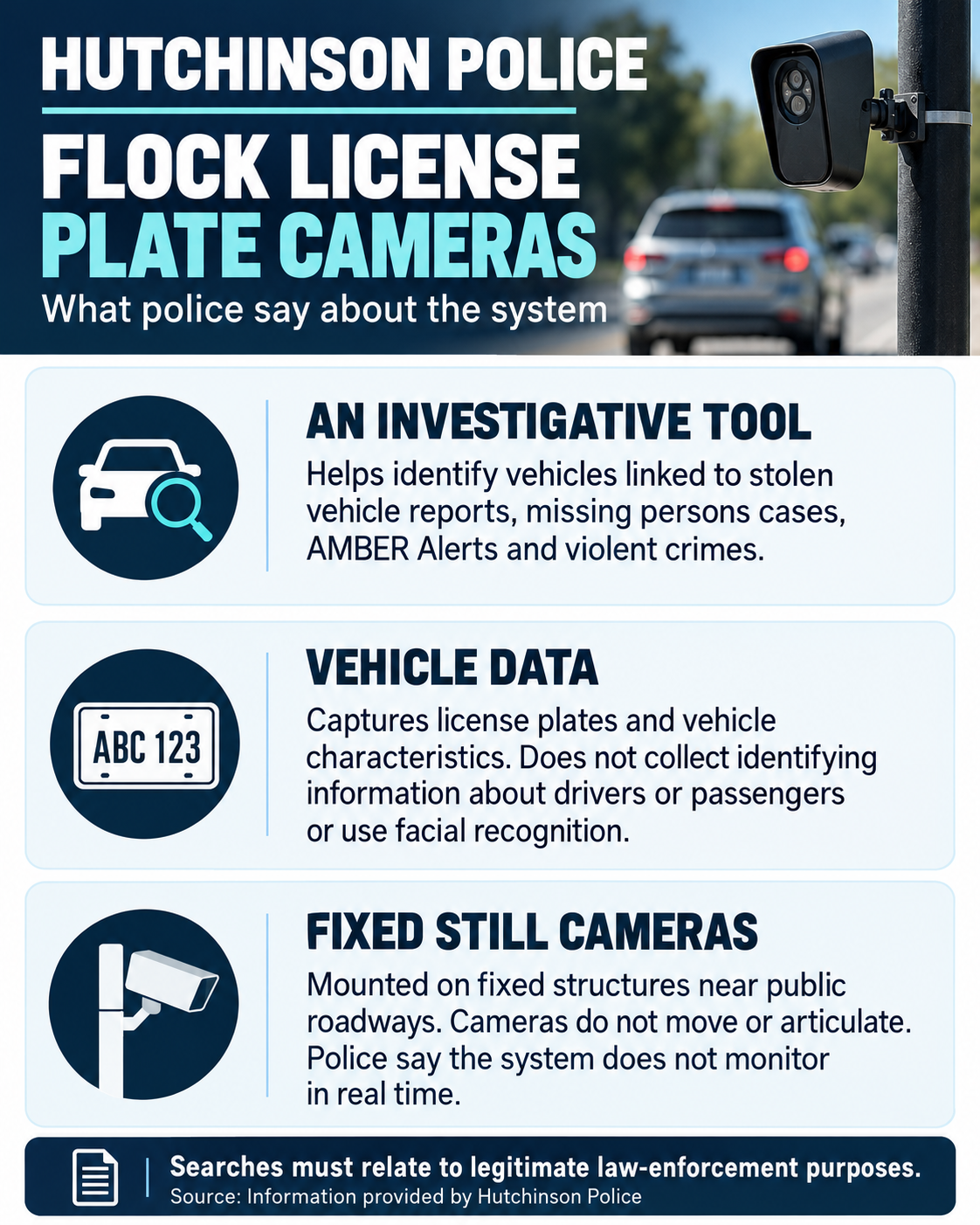
Burlie described the cameras as tools for generating investigative leads in cases involving missing or endangered people, wanted suspects, stolen vehicles, and other crimes.
“ALPR alerts are investigative leads, not automatic grounds for a stop or enforcement action,” Burlie said.
Officers must independently verify information associated with an alert before taking enforcement action, he said.
Much of the discussion focused on safeguards governing access to the system. Burlie said access is limited to trained, authorized officers and the department’s crime analyst. Each search requires a case number, a reason, and an offense type.
LINK: Hutchinson Police information page on FLOCK ALPR cameras
The department has disabled search categories for immigration enforcement, traffic enforcement and civil matters, according to the presentation.
Vehicle images are retained for 30 days before being purged. Records documenting searches, including the user, search terms and investigative justification, are retained indefinitely.
Burlie said that search records allow the department to investigate complaints raised months or years later. He clarified that the retained search history does not preserve the corresponding vehicle photographs.
Department policy requires weekly audits of search activity. Automated notifications flagging unusual officer usage are expected to begin in January 2027.
LINK: FLOCK Transparency portal — Hutchinson Police Department
Police reported sharing license plate reader information with 104 Kansas law enforcement organizations, 17 out-of-state organizations and one federal organization, identified during the presentation as the U.S. Postal Inspection Service. Burlie said outside agencies’ searches of Hutchinson’s data are subject to documentation requirements and auditing.
Council members questioned whether vehicle photographs could reveal information about occupants, even without facial recognition.
Hutchinson Police Operations Capt. Dustin Loepp said camera angles generally limit the ability to identify faces. However, he acknowledged that visible details, including a person’s tattooed arm extending from a window and property in pickup beds, have provided investigative leads.
Council member Stacy Goss asked whether someone would be notified if an officer improperly searched their vehicle information.
Burlie said notification would depend on the circumstances, including whether the misuse caused harm or created the potential for future harm. Suspected misuse would be addressed through the department’s disciplinary process.
Residents who believe their information has been improperly accessed can file a complaint with the department. Burlie said requests for search records also can be submitted through the records division, although disclosure may be limited by an active investigation or another person’s private information.