


MARC JACOBS
Hutch Post
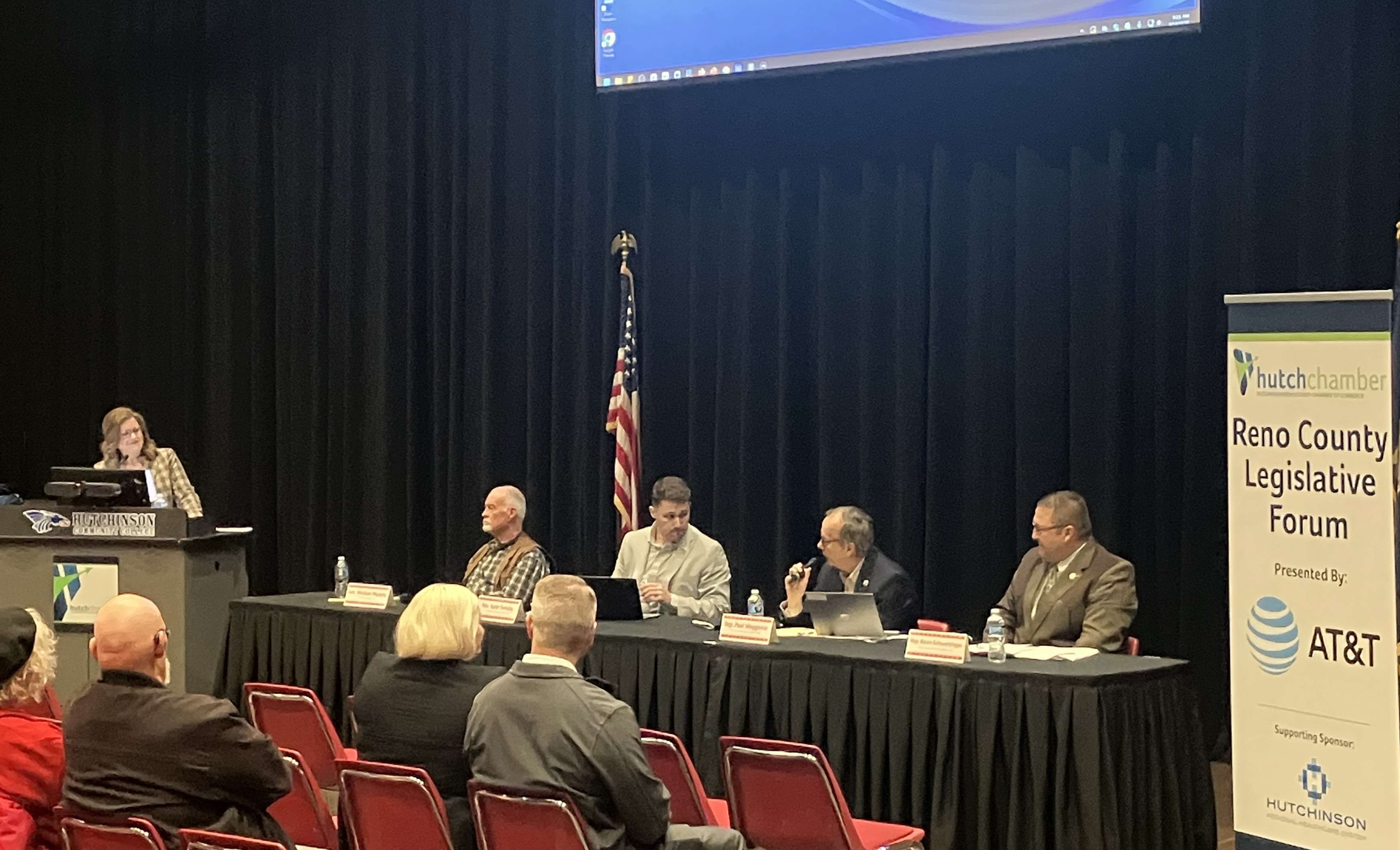
Reno County lawmakers fielded questions Saturday during a legislative forum hosted by the Hutchinsn/Reno County Chamber of Commerce at the Stringer Fine Arts Center on everything from property tax relief and school cell phone policies to prison construction and campaign-style advocacy by public agencies, offering a preview of the issues likely to dominate the final stretch of the 2026 legislative session.
Senator Michael Murphy, Representatives Kyler Sweely, Paul Waggoner and Kevin Schwertfeger were in attendance, Rep. Joe Seiwert was invited, but did not attend due to recovering from a battle with an illness. The panelists said they are still sorting through competing proposals to curb rising property taxes, including bills that would cap valuation growth, require votes for bigger increases and provide incentives for local governments that limit revenue hikes. They also discussed a more sweeping idea from Sen. Mike Murphy to eliminate property taxes altogether and replace them with a capped retail surcharge.
“We’re trying to deal with that,” Rep. Kyler Sweely said of property taxes, describing it as a difficult balancing act as legislators face pressure to restrain state spending while meeting demands for schools, infrastructure and public services.
Energy siting bill draws limited comment
Audience questions opened with House Bill 2728, which would require the Kansas Corporation Commission to establish uniform sitting and permitting standards for certain energy facilities and would limit some local government actions related to permitting.
The lawmakers said they had not reviewed the measure closely because it remains in committee and is outside their assignments. One said the proposal is the type of bill he would expect to track more closely once it clears the committee and reaches the full House.
Sales tax authority, property tax caps debated
A longer discussion centered on House Bill 2712 and House Bill 2745, both tied to broader debates about how Kansas should finance local government and schools.
HB 2712 would expand authority for countywide retailer sales taxes, allow certain dedicated apportionments of special-purpose tax revenues and limit special-purpose city and county sales taxes to 10 years, according to a summary read at the forum.
Rep.Waggoner said current Kansas law creates a disincentive for counties to rely on sales tax, noting that once a county exceeds 1% on its sales tax rate it must seek legislative approval to go higher — a step he characterized as outdated and one that can encourage reliance on property taxes instead.
“Frankly, all that does is incentivize counties to raise their property tax rather than go to the sales tax,” he said, adding that requiring the Legislature’s approval can push counties toward what he called the “easy way” to raise revenue.
Lawmakers also addressed HB 2745, which was described at the forum as having multiple parts and drawing a contentious response in committee. Waggoner said the bill “went over like a lead balloon” in a hearing, despite the credibility of its sponsor, House Taxation Committee Chairman Adam Smith.
Another lawmaker contrasted what he described as differing House and Senate approaches to property tax relief — including a valuation-cap concept and a revenue-neutral framework aimed at limiting local tax growth to a range tied to inflation and encouraging compliance through incentive funding.
Underlying both approaches, multiple panelists said, is the same core tension: restraining government spending while responding to local demands.
Murphy pitches “Property Tax Freedom” plan
Murphy, discussing Senate Bill 488 — which he said would need a constitutional amendment to remove property taxes from Kansas’ constitution — argued property taxes have become unsustainable for some homeowners, particularly those on fixed incomes whose home values rise faster than their ability to pay.
Murphy compared property taxes to “the Titanic,” saying the system has “struck the iceberg” and lawmakers can only “rearrange the deck chairs” unless they embrace a bigger change.
Murphy said SB 488 would replace property taxes with a small surcharge on purchases, capped per transaction. Under his outline, the surcharge would be 7.6% up to $20, topping out at $1.60. A $25 item would add $1.60, he said, while a much more expensive purchase — such as a vehicle — would also add $1.60 because of the cap.
Murphy said the proposal would exempt certain essentials such as utilities and groceries and would broaden the base so “everybody pays,” arguing that existing exemptions can shift costs onto remaining taxpayers. He said the approach could capture money from out-of-state travelers and would make Kansas more attractive economically if property taxes were eliminated.
“What do you think is going to happen if we don’t have property tax?” Murphy said, predicting it would spur investment and help housing affordability by removing a recurring cost borne by homeowners and embedded in rents.
Other lawmakers were more cautious. Waggoner credited Murphy for “thinking out of the box” but said the core issue remains spending: shifting from property tax to a consumption-based system would not automatically limit what government spends.
Rep. Sweely raised concerns about border communities, where shoppers might cross into nearby states if they feel a consumption tax is too high — a dynamic lawmakers said they would need to study if the proposal advances.
Prison construction in Hutchinson resurfaces
The forum also revisited ongoing concerns over the Hutchinson Correctional Facility, where lawmakers and corrections officials have cited aging infrastructure and design issues.
Representative Sweely, whose district includes the prison, said Gov. Laura Kelly previously included funding for a new Hutchinson prison in a past budget proposal but does not include it in her current budget. The lawmaker estimated replacement costs in the hundreds of millions, and said legislators would need to consider bonding or other financing mechanisms.
Sweely called the existing prison “pretty rough,” describing conditions as deteriorated and arguing that a new facility could strengthen local employment and help Hutchinson retain workers who now commute from outside the county.
Panelists emphasized that the Legislature — not the governor — ultimately appropriates funding. Several said Kansas has shifted toward a more Legislature-driven budget process, with legislative committees developing recommendations in advance, making the governor’s budget proposal less determinative than it once was.
On the question of where a new prison would be built, one lawmaker said state-owned land near the current site appears the most likely option because it would reduce acquisition costs, though he said community input would be considered.
KPERS changes seen as unlikely
Asked about proposals to eliminate KPERS 3 and move workers to KPERS 2, lawmakers said the change faces steep costs and would be difficult to pass.
Waggoner said legislation is introduced nearly every year but “has a very, very minimal chance to ever pass,” citing estimates of hundreds of millions of dollars in upfront state funding required to make the shift.
Cell phones in schools, special education funding
On cell phone policies in schools, lawmakers said Gov. Kelly has urged legislators to send her a bill restricting student cell phone use, and some predicted a measure could advance soon. Panelists discussed balancing statewide standards with local control and noted research suggesting student mental health and classroom outcomes can improve after districts adopt restrictions, though the adjustment can take time.
Special education funding sparked a broader debate. Lawmakers acknowledged that Kansas does not currently meet a commonly cited benchmark of covering 92% of excess special education costs, but multiple panelists said the issue is complicated by how spending is counted and the constraints of state budgeting.
One lawmaker said any increase creates “maintenance of effort” obligations, meaning new funding levels become an ongoing commitment rather than a one-time appropriation. Another pointed to rising per-student spending overall while warning that academic outcomes have not risen proportionately.
Conservation fund and “heirs property” act
Lawmakers also discussed House Bill 2063, which would establish a statewide conservation fund aimed at supporting working lands, outdoor recreation and wildlife. One panelist said an original request for $60 million was reduced in discussion to a smaller amount and could potentially be paired with federal matching funds if enacted.
Another lawmaker voiced support for directing resources to rural communities and conservation needs but raised concerns about how outside groups might influence the program’s administration; arguing conservation districts should play a central role.
A separate question focused on the Uniform Partition of Heirs Property Act, legislation intended to help prevent forced sales that can break up family farms when heirs disagree about property. One sponsor said the effort has struggled to advance, noting opposition from some interests and the challenge of securing hearings amid packed committee schedules.
Veto override expected on bathroom bill
The panelists also said they expect to override Kelly’s veto of a bill restricting transgender individuals’ access to bathrooms and changing rooms in government-owned buildings. Lawmakers said the bill passed with a veto-proof majority and described the measure as rooted in biological distinctions and privacy concerns.
Public advocacy by government at issue
Rep. Paul Waggoner also highlighted House Bill 2451, which would prohibit governments from using public assets to advocate for or against proposed ballot questions. Waggoner said the bill was prompted in part by controversies he described in Hutchinson tied to public messaging during a recent school bond campaign.
Waggoner said Kansas law already bars the use of public funds to support candidates but is less explicit on ballot measures, leaving what he called a gap between permissible public education efforts and advocacy.
He said the proposal is intended to clarify that line and create consistent rules statewide.
The next forum, hosted by the Hutchinson/Reno County Chamber of Commerce, is scheduled for March 14.